

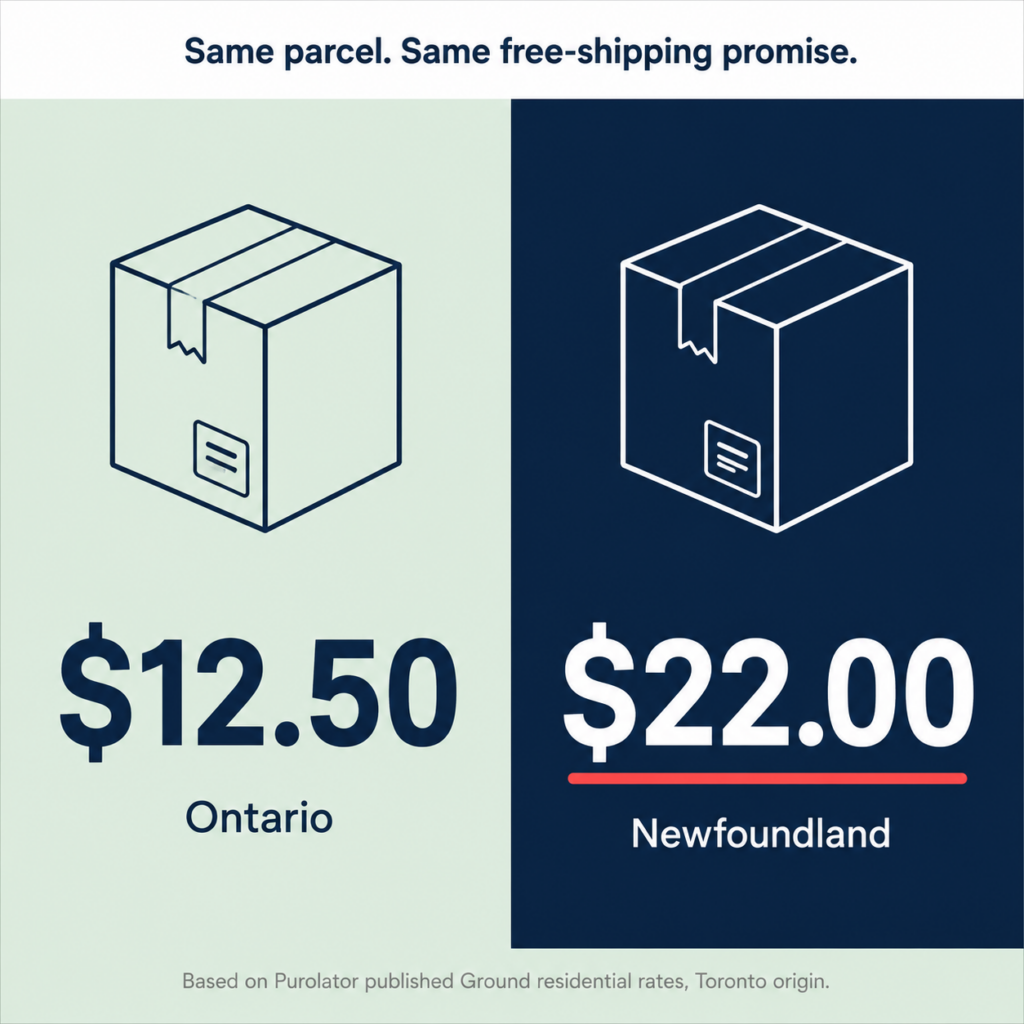
A typical online order leaving a Toronto warehouse costs about $12.50 to ship to a customer in Ontario. The same order costs about $22 to reach Newfoundland. Same product, same free-shipping promise, and the second parcel takes $9.50 more out of your margin. Most Canadian merchants have never worked out their shipping cost province by province. They set one nationwide free-shipping offer against their average cost, and that offer loses money on every order headed east or north.
At Part n Parcel we manage shipping for 240+ Canadian e-commerce businesses. Their invoices show the typical merchant paying roughly 30% above benchmark to move the same parcels.
Free shipping comes out of your margin, and how much it takes depends on your carrier rate. When the carrier account is in your own name, you can see that rate line by line and raise problems with the carrier directly. When your parcels ride on someone else’s account, you are pricing an offer off a number you cannot check.
The Free Shipping Cost Stack
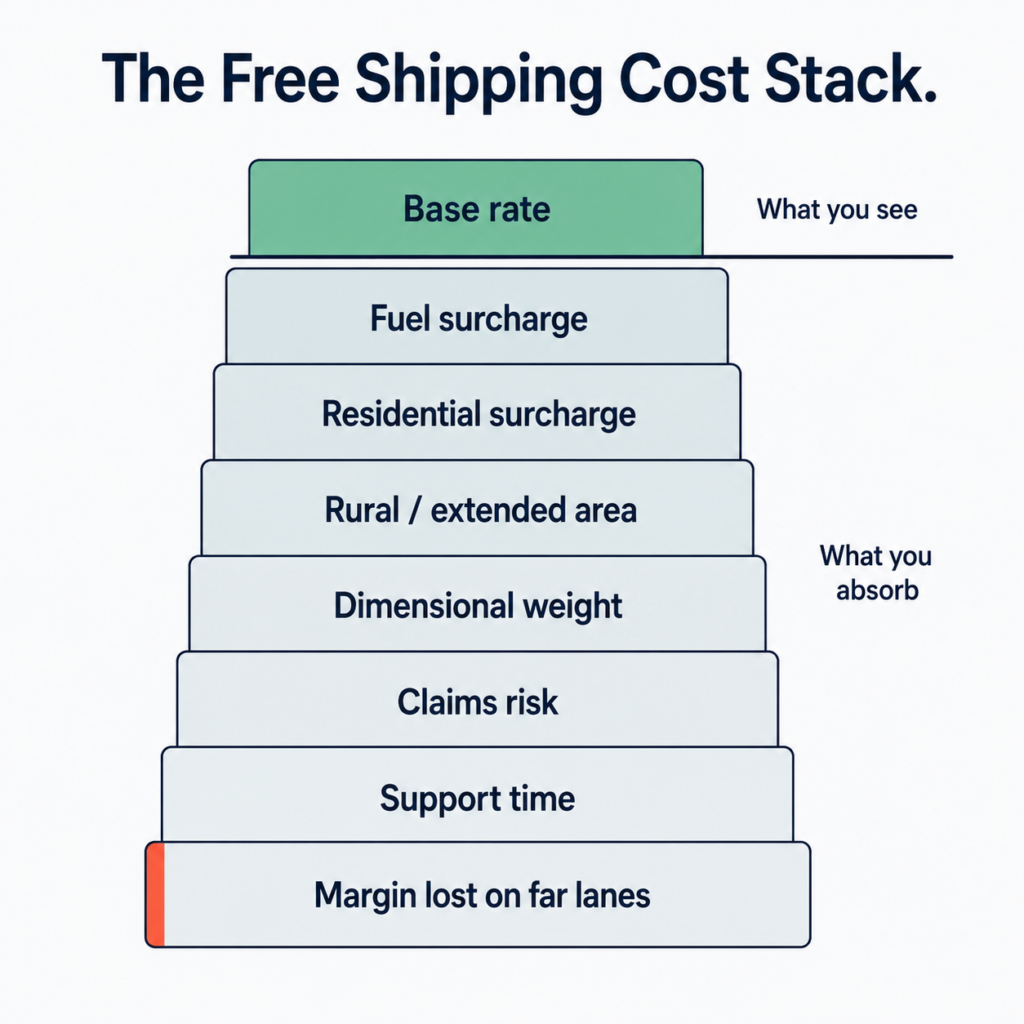
The rate on the carrier’s website is the first of eight numbers. Together they make up the Free Shipping Cost Stack:
Real cost per parcel = base rate + fuel + residential + rural + dimensional weight + claims risk + support time + margin lost to expensive lanes
A lane is one origin-to-destination route, like Toronto to St. John’s. The threshold formula most merchants run uses the first number in the stack and none of the rest.
Fuel surcharges change over time and apply to transportation charges and selected fees, depending on the carrier. Check the current Canadian Fuel Surcharge Tracker and your agreement before calculating your full shipping cost.
A residential delivery fee of around $4.80 per package (FedEx Ground and Home Delivery, 2026) applies to almost every order you send, because you are shipping to homes, not loading docks. Rural and remote addresses carry their own surcharge, and those are the destinations that already cost the most to reach. Dimensional weight pricing bills you for the size of the box rather than the weight of what is inside, so a light product in a large protective box gets charged as if it were heavy.
Because fuel is a percentage, it scales with whatever base rate you are on. If a markup is built into that base rate, you pay the fuel surcharge on the markup too. You cannot audit a rate you cannot see, and the rate is only visible to you when the account is in your name.
Why Canadian geography breaks national free shipping
Most Canadian shoppers live in a handful of big cities that are cheap to deliver to. The rest are spread thinly across the rest of the country, many of them in remote areas that cost far more to reach. Offer everyone the same free shipping and the city orders end up subsidizing the remote ones.
The figures below are directional, built from Purolator’s published rates for a 0.5 to 1 kg ground residential parcel shipped from Toronto. Your own invoice has the exact numbers, and on every carrier the cost rises the farther east or north a parcel travels.
| Province | Cost per parcel |
| ON | $12.50 |
| QC | $13.00 |
| MB | $13.00 |
| SK | $13.25 |
| AB | $13.50 |
| NB | $15.00 |
| NS | $16.75 |
| PE | $17.00 |
| BC | $17.25 |
| NL | $22.00 |
Across the invoices we review, the median parcel that crosses a provincial line costs $28.02. This broader invoice sample is not a like-for-like comparison with the lightweight parcel example above.
National brands already leave the territories and the most remote regions out of their free-shipping offers, and there is nothing unusual about doing the same. Most small and mid-sized merchants have never run the numbers. They keep funding one nationwide offer from a single average cost, and the expensive routes take the difference out of margin.
How a bad rate inflates your free-shipping threshold
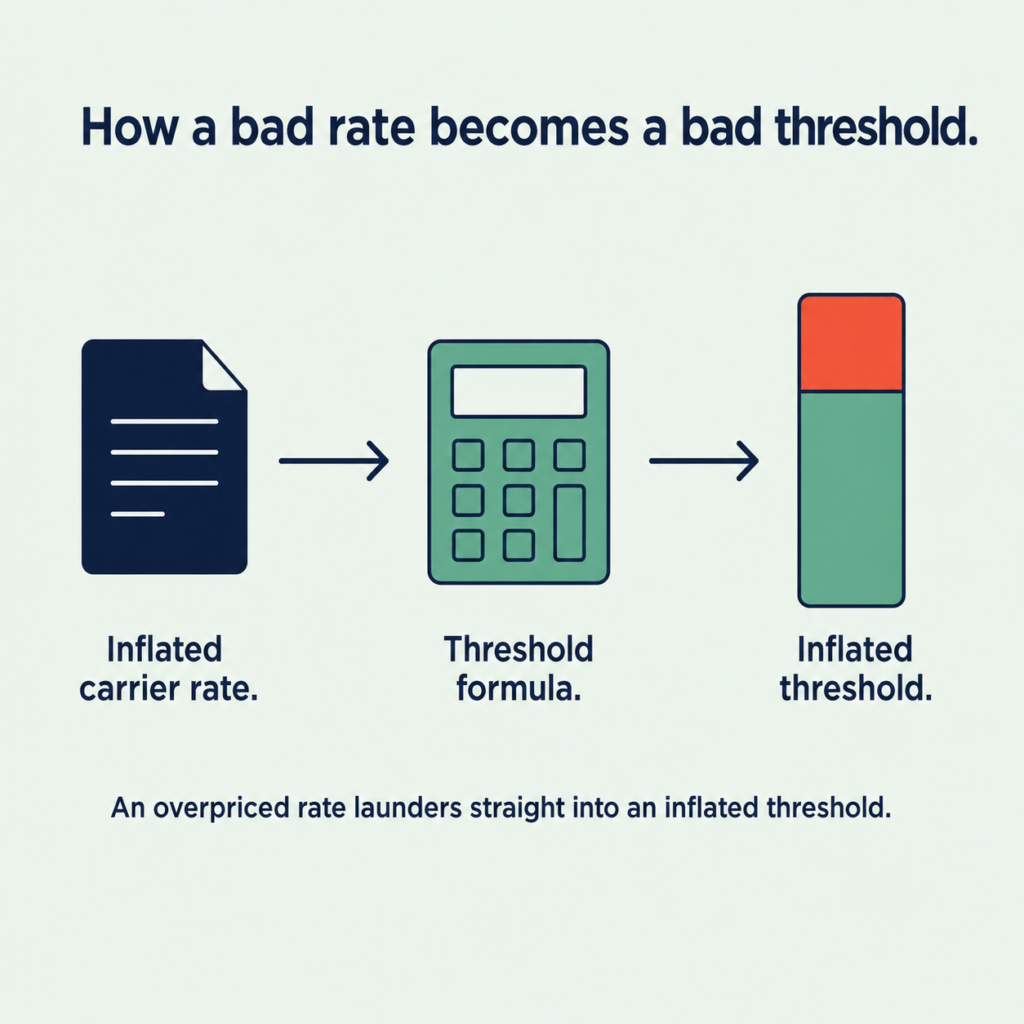
Most threshold advice never checks whether the rate you start from is any good. Every guide hands you the same formula.
Free-shipping threshold = (average shipping cost / gross profit margin %) + average order value
Use gross profit margin, not net margin. Gross profit margin is what is left after the cost of the product itself. Net margin subtracts all your other expenses too, so if you use it here, the formula returns a threshold far too high to use.
The formula works fine. What breaks it is the shipping cost you feed in, which for most merchants is already too high. The typical merchant we audit is paying roughly 30% above benchmark. Put a too-high rate into the formula and you get a too-high threshold back. A bad rate launders into a bad threshold.
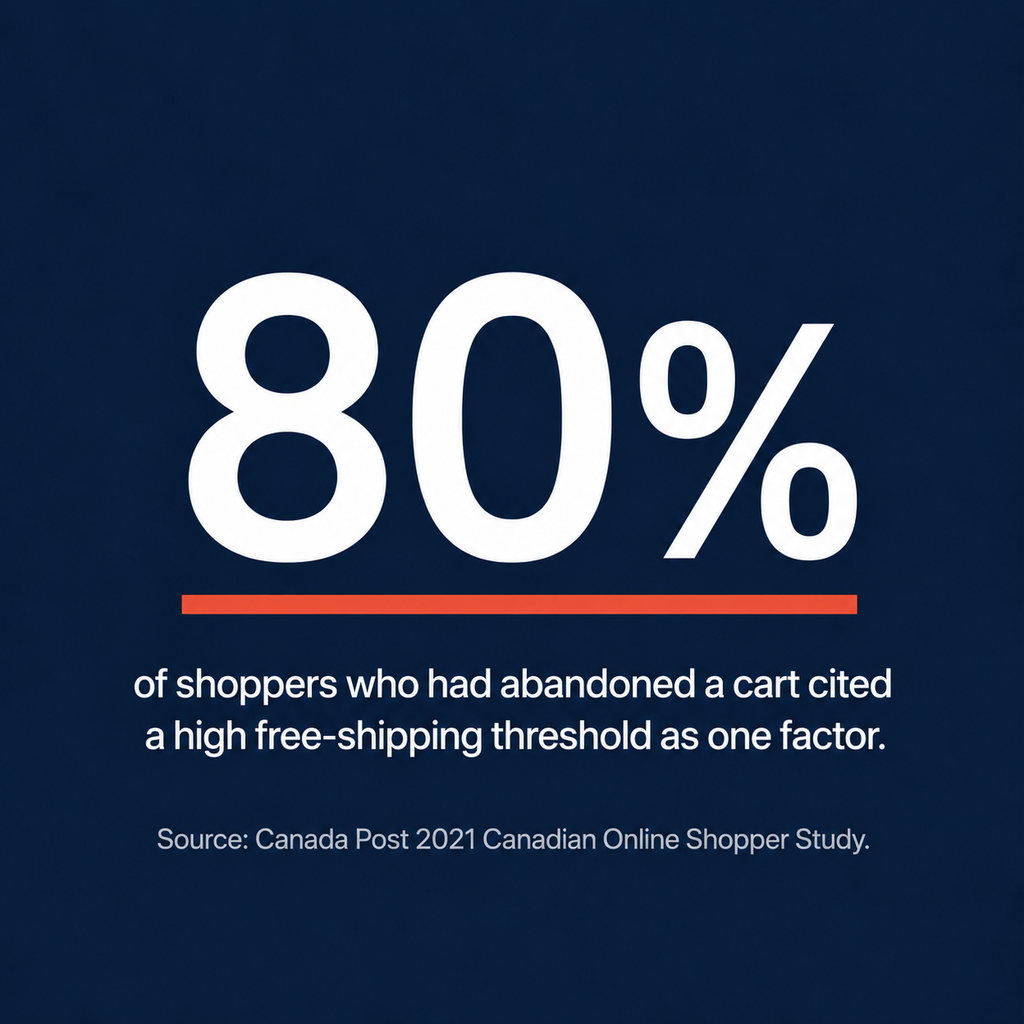
When your threshold is too high, you still absorb the shipping cost on the orders that reach it. And the shoppers who do not reach it often leave without buying. In the 2021 Canada Post Canadian Online Shopping Survey, 80% of shoppers who had abandoned an online cart said a free-shipping threshold set too high was one of the reasons, and 92% named the cost of shipping itself. An overpriced rate is what pushed the threshold that high to begin with.
The full cost of shipping a parcel decides whether each free-shipping offer makes money or loses it, and your carrier rate sets that cost. A direct account in your own name does not let you set the price. It gives you the carrier’s actual rate on the page, an invoice you can audit line by line, and a carrier rep you can call when a route starts failing. The price itself moves when you qualify for a carrier’s enterprise rate program. Pricing and account support depend on the carrier, shipment profile and agreement. Collective volume can improve negotiating leverage.
Part n Parcel’s network agreement aggregates volume across 240+ Canadian e-commerce businesses so individual merchants qualify for enterprise rates they could not reach on their own. We set up the accounts, configure the platform, and keep working the rate as fuel, annual increases and carrier mix change. Enterprise rates also have to be defended once you have them, and you need to see the rate to know whether that is happening.
What a bad rate costs in dollars
Across the invoices we review, the same parcel costs several dollars more on a poor rate than on a good one. The illustrated comparison is $4.81 per parcel, or 30.4% below the original $15.84 cost.
| Scenario | Bad rate | Better rate | Difference |
| 1 free order | $15.84 | $11.03 | $4.81 |
| 100 orders/day | $1,584 | $1,103 | $481/day |
| Annualized example (250 shipping days) | $396,000 | $275,750 | $120,250/year |
At 100 orders per shipping day over 250 shipping days, the illustrated $4.81 gap totals $120,250 per year. This is an illustration, not a guaranteed outcome. Same parcels, same customers, same boxes.
That $120,250 is not a discount. It is the free-shipping budget the merchant already had.
How these numbers were built. Median all-in cost per domestic parcel across 22,353 parcels from 11 Canadian e-commerce businesses on 2026 invoices. All-in means the base transportation charge plus fuel, residential, rural and remote, and dimensional weight adjustments. GST, HST, PST and duties are excluded. The bad rate and better rate columns are matched pairs: same origin province, same destination province, same service level, and same billed weight band, so the difference comes from the rate card rather than from a different parcel. Figures are directional and your own invoice is the number that counts. Full dataset in our 2026 Canadian e-commerce shipping cost benchmarks.
Run your numbers in the free Shipping Policy Builder
What a cheap carrier costs beyond the label
If a parcel goes missing, every major Canadian carrier covers only about $100 by default, and Canada Post’s cheapest service, Regular Parcel, covers nothing at all unless you buy coverage. A lost $400 order pays out $100, if it pays at all.
You might think you can fix this by declaring the parcel is worth $400. You can enter that number, but declared value is not insurance. It raises the most the carrier could pay, nothing more. To collect anything, you still have to prove what the item was worth and that the carrier lost or damaged it, and that proof is on you. Claim windows are short and vary by carrier, so a loss you discover late can be uncollectible no matter what coverage you bought.
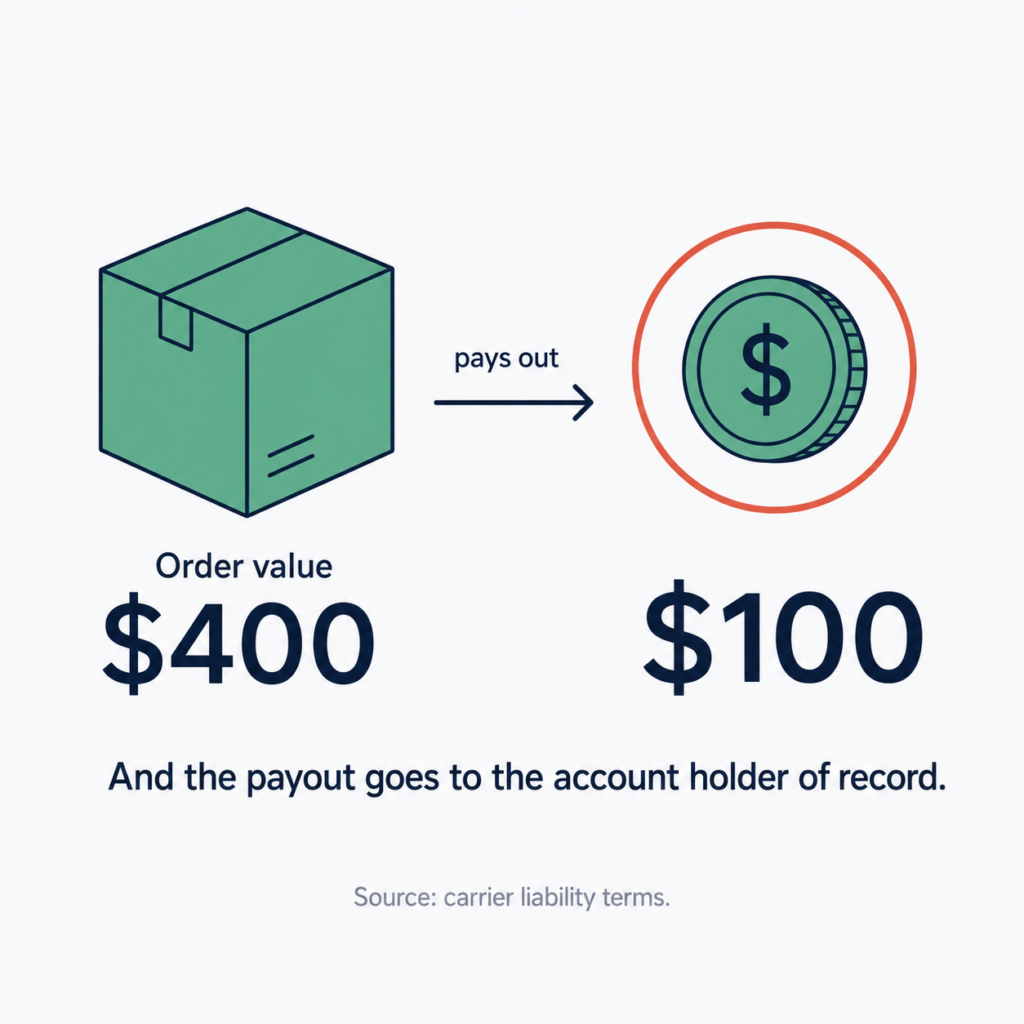
When a claim is finally paid, the money goes to whoever owns the carrier account. If you ship through an aggregator, which is a platform that runs your parcels on its own account, the payment goes to the aggregator and you are left chasing them for your own money.
A cheap service often ships with poor tracking, so customers email asking where their order is. These “where is my order” messages, known as WISMO, make up about 18% of all e-commerce support tickets, and the share runs higher for brands on budget carriers. Each one costs $5 to $12 to answer by hand, enough to wipe out most of the slim margin a free-shipping order was supposed to protect.
When free shipping works and when it doesn’t
Free shipping fails when you build it on an average cost you cannot see or check. Once you know the full cost of shipping a parcel, you can pick the approach that fits your numbers.
| Free shipping approach | Use it when |
| Free shipping nationwide | your average cost is low enough to cover every destination, including the expensive ones |
| Province carve-outs | expensive destinations like Atlantic Canada, the territories, or remote BC are draining your margin |
| Threshold free shipping | your average order value is high enough to cover shipping at a threshold customers will still reach |
| Free standard plus paid express | customers in a hurry will pay for express, which helps cover the cost |
| Transparent calculated shipping | the numbers do not work for free shipping, so you charge a fee tied to what each delivery costs, which customers find fairer than an arbitrary flat fee |
A cheap regional carrier can be excellent. FleetOptics, a regional carrier covering Ontario, reports better than 99% delivery performance on the routes it serves. That figure is FleetOptics’ own published claim, not a number we measured. What burns merchants is chasing the lowest label with no service data behind it and nobody accountable when a delivery fails. Regional carriers as a category are not the problem.
Budget options can also disappear. Sendle halted all parcel bookings in Australia and Canada in January 2026 after its parent company was unable to secure the capital to keep operating. Any merchant whose free-shipping offer was built on Sendle rates lost those rates within days.
What to do before you set your threshold
Run through these steps before you set or change your threshold:
- Pull your last 30 days of carrier invoices.
- Work out the full cost of shipping a parcel to each province, counting fuel and every surcharge, not just the base rate.
- Put that full cost, along with your gross profit margin, into the threshold formula.
- Decide which expensive destinations to leave out of your free-shipping offer.
- Recheck whenever your invoice changes. Annual rate increases and fuel swings raise your cost per parcel and leave a threshold you set months ago sitting on numbers that no longer hold.
Every number here comes off your own invoices. For the full mechanics of writing the policy once you have those numbers, see our shipping policy operator’s guide. For cutting shipping costs more broadly, see how to reduce shipping costs for Canadian e-commerce. And for the surcharges that never show up on a quoted rate, see hidden shipping costs in Canadian e-commerce.
Frequently asked questions
How much does free shipping actually cost a Canadian e-commerce store?
More than the carrier’s quoted rate. The Free Shipping Cost Stack has eight layers: base rate, fuel, residential, rural, dimensional weight, claims risk, support time, and the margin you give up on expensive lanes. Most merchants price their offer off the first layer alone. On the invoices we review, the gap between a typical inflated rate and a better one runs about $4.81 per parcel, which is margin on every free order you send.
How do I calculate a free-shipping threshold in Canada?
Start with this formula. Free-shipping threshold = (average shipping cost / gross profit margin %) + average order value. Use gross profit margin, not net margin. Gross profit margin is what is left after the cost of the product itself; net margin takes out all your other expenses too and would push the threshold far too high to use. The formula is only as good as the shipping cost you feed it, so work out your full cost per parcel first. Our shipping policy operator’s guide walks through the full mechanics.
Why does shipping to Newfoundland and Atlantic Canada cost so much more?
Carriers price by distance zone, and most Canadian e-commerce ships out of Ontario. A standard parcel that costs about $12.50 to deliver in Ontario runs about $22 to Newfoundland from the same warehouse. The longer distance and the smaller number of deliveries spread across Atlantic Canada push the cost up.
Should I offer free shipping across all of Canada?
Only if your average shipping cost is low enough to cover every destination, including the expensive ones. If regions like Atlantic Canada or the territories are taking more margin than those orders return, leaving them out of the free-shipping offer is a common and sensible move that national brands already make. Work out the cost province by province before you commit to one nationwide promise.
What is a good free-shipping threshold for a Canadian store?
Canada Post’s 2021 Canadian Online Shopper Study found shoppers are most willing to top up a cart or pay for shipping on baskets worth between $50 and $100. Use that range as a sanity check on your own number. Set the threshold itself from your cost per shipment, because a competitor with a better rate card can afford a threshold you cannot.
Why is my free shipping no longer profitable?
Annual rate increases and changing fuel surcharges can raise your cost per parcel while your threshold stays fixed. Pull your invoices and recalculate using current costs. Our guide on why shipping rates go up covers the other increases that move the floor under a threshold you set once.
Before you raise your threshold again
The roughly 30% gap we see on most invoices is there because merchants are setting free-shipping rules on rates they have never audited and, in many cases, cannot see.
So before you raise your free-shipping threshold again, send us one invoice. We will show you whether your free-shipping budget was already sitting in your rate card. Written analysis in 48 hours, no call required.
Every unaudited invoice is margin you’re giving away.