
What to charge, what to offer free, and how to keep shipping from eating your margin. Written for Canadian e-commerce stores on Shopify, WooCommerce, BigCommerce, and Magento, doing 50 to 500 orders a day.
The right shipping policy comes down to one ratio: what you pay your carrier per shipment divided by your average order value (AOV). When that number sits below roughly 10 percent, a free shipping threshold usually pays for itself. Between 10 and 16 percent, a flat rate or a threshold with a charge below it protects your margin. Above 16 percent, your carrier rates are likely the constraint before your policy is. Those bands come from Part n Parcel’s experience with Canadian merchants, not a published study. The benchmarks underneath them (Shippo’s category data, ShipStation’s merchant guide, Baymard’s cart abandonment research, Purolator’s published rates) are public, and we cite them throughout this guide.
Most Canadian merchants are running policies built for US economics on Canadian cost structures. The gap shows up at the end of the year as missing gross profit. This guide covers what works north of the border, the math behind each option, and how to set your own numbers using your own invoice.
But there’s a layer underneath the policy that most merchants never see, and it’s the one that matters most. A shipping policy decides how much of your carrier cost the customer absorbs. It does nothing about the carrier cost itself. If you don’t own the carrier account, you don’t control the input the whole policy is built on. You’re tuning the dials on a number someone else sets. We come back to this at the end, because it’s the part the policy can’t fix.
What healthy shipping cost looks like
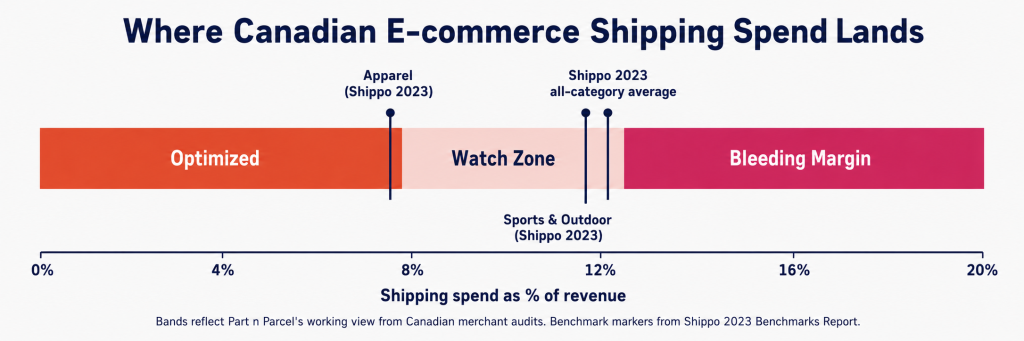
Before you pick a policy, you need a benchmark. Shippo’s 2023 E-commerce Shipping and Fulfillment Benchmarks Report tracked mid-market merchants across six categories. The all-category average was 10.95 percent of order value spent on the shipping label alone.
| Category | Average order value | Average shipping label cost | Shipping as % of AOV |
| Apparel | $109.57 | $9.27 | 7.82% |
| Beauty / skincare | $94.22 | $8.38 | 8.34% |
| Electronics | $152.92 | $16.45 | 9.94% |
| Health / wellness | $71.90 | $8.19 | 10.48% |
| Jewelry | $78.79 | $8.01 | 9.45% |
| Sports & outdoor | $137.77 | $16.12 | 10.81% |
Source: Shippo 2023 E-commerce Shipping and Fulfillment Benchmarks Report.
A second public benchmark to anchor against: ShipStation’s Shopify Merchant’s Shipping Guide describes shipping running 10 to 20 percent of profit margins as the standard range for small to mid-market e-commerce. That is a different denominator (margin, not revenue) and a different ceiling. Watch both.
The practical bands we use with the Canadian merchants we work with at Part n Parcel:
- Under 8 percent of revenue: generally workable. A free shipping threshold or an always-free policy is often defensible at this level.
- 8 to 12 percent of revenue: the watch zone. A threshold-with-charge or flat rate tends to be safer until you have renegotiated carrier rates.
- Above 12 percent of revenue: in our experience, the carrier rates are usually the constraint, not the policy. Fix the input before you rewrite the policy.
These bands are Part n Parcel’s view, not a published industry standard. They sit conservatively below Shippo’s all-category average of 10.95 percent because the merchants we work with on managed shipping economics are actively trying to get there, not benchmark to it.
If you’re sitting above 12 percent and you’re not sure whether it’s your policy or your rates driving it, our Shipping Policy Margin Calculator is built for exactly that question. Four questions, sixty seconds, and it tells you in plain English what’s pushing your rates up and roughly what it’s costing you a month.
The five e-commerce shipping policies, compared
Shopify, WooCommerce, BigCommerce, and Magento all offer the same five ways to charge for shipping. Each one solves a different problem.
| Policy | Best for | Watch out for |
| Flat rate | Products that ship at roughly the same weight and size. Stores that want simplicity at checkout above all else. | You lose money on heavy orders and on shipments to PEI, Newfoundland, and the territories. You make money on Ontario and Quebec. The math only works if you’re selling enough in Ontario and Quebec to cover the losses elsewhere. |
| Free above a threshold | Stores whose carrier cost sits comfortably below 10 percent of AOV. The single highest-leverage move for lifting average order value. | If the threshold is too low, you give shipping away on orders that would have shipped at the lower price anyway. Too high and nobody stretches to qualify. |
| By province | Stores selling across Canada that want to stop using Ontario revenue to cover Atlantic shipping costs. Higher honesty, slightly more friction at checkout. | Customers in Atlantic Canada and the territories will see numbers they may not expect. Be ready to explain why. |
| By weight | Stores with high variance in product weight. Heavy items and light items in the same catalog. | Friction at checkout. Customers want a number before they commit. Set both what you charge per tier and what each tier actually costs you, so you can see the margin on each one. |
| Live carrier rates | High-AOV stores or stores with unpredictable parcel sizes. The most accurate option. | Customers see different rates on different days. That erodes trust unless you explain it. Requires Shopify Advanced or higher, a WooCommerce or BigCommerce plugin, or a Magento extension, plus a carrier account connected to your store. |
| Always free | Stores with high margins, low parcel cost as a share of AOV, or a deliberate brand position around it. The strongest signal you can put at checkout. | The cost shows up at the end of the year, not on each order. Run the annual math before you commit. |
Extra costs at checkout (shipping included) are the single largest preventable reason carts get abandoned, according to multi-year research from the Baymard Institute. Whatever policy you pick, the test is how it lands the moment the customer sees the total. If the number surprises them, you lose them.
The Canada-specific problem most US advice misses
Most shipping policy advice online is written for US merchants shipping from a warehouse in Texas or Tennessee to anywhere in the lower 48 for roughly the same cost. Canada does not work that way.
Canadian carriers price by distance from your origin. Ontario and Quebec are cheap because most fulfillment centres are there. British Columbia and Alberta cost more because of distance. Atlantic Canada, the territories, and rural postal codes carry the highest rates because of distance plus rural delivery surcharges.
Here is what a 0.5 to 1 kg parcel costs to ship from a Toronto-area origin on Purolator’s Ground residential rates, effective September 2025:
| Province | Approximate cost per shipment |
| Ontario | $13.71 |
| Quebec | $14.45 |
| Manitoba | $17.59 |
| Saskatchewan | $18.27 |
| Alberta | $18.85 |
| British Columbia | $19.62 |
| New Brunswick | $17.84 |
| Nova Scotia | $18.31 |
| Prince Edward Island | $19.07 |
| Newfoundland & Labrador | $21.43 |
| Yukon / NWT / Nunavut | $28 to $45+ |
Source: Purolator Rate Guide, effective September 1, 2025. Real rates depend on your account tier, parcel dimensions, fuel surcharge, and any residential or remote-area fees.
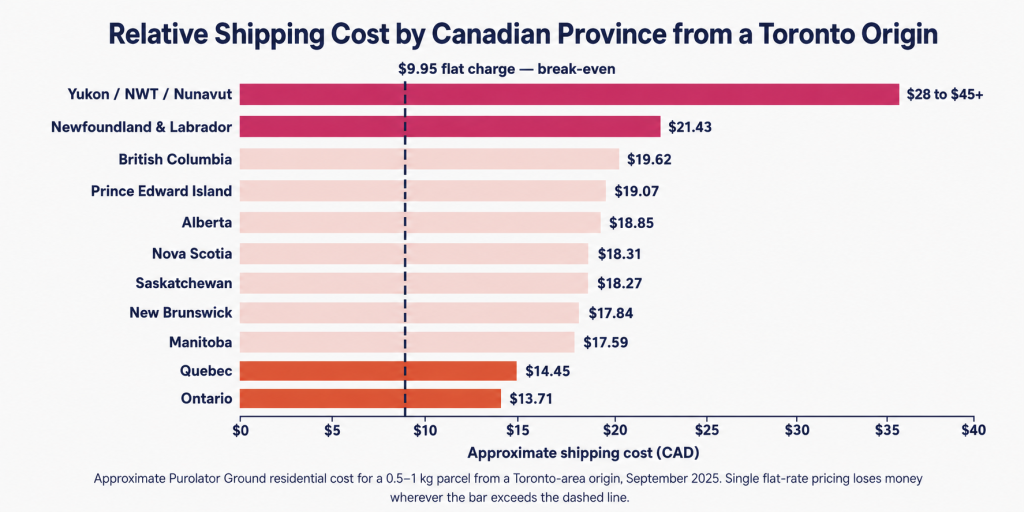
If you charge a single $9.95 flat rate across Canada, you’re $3.76 short of the published cost on every Ontario shipment ($13.71 minus $9.95) and $11.48 short on every Newfoundland shipment ($21.43 minus $9.95). Negotiated account rates sit below published, which is how Ontario and Quebec shipments end up profitable while Atlantic shipments stay deep underwater. The math works when your order mix is heavy on Ontario and Quebec. It breaks the moment your Meta ads start converting in Halifax and St. John’s.
This is why province-based pricing is the most underrated policy in Canadian e-commerce. A small amount of friction in exchange for the truth about where you make money.
Notice what’s driving every number in that table: your account tier. The published rate is the starting point, and the gap between published and what you actually pay is decided by whose account the parcel ships on. A merchant on their own direct carrier account negotiated at enterprise volume pays a different number to Newfoundland than a merchant pulling rates off a platform’s shared account. Same parcel, same destination, different input. The policy you build on top of that input is downstream of a decision you may not have made deliberately.
How to set a free shipping threshold that actually lifts AOV
The free shipping threshold is the single highest-leverage move available at e-commerce checkout. According to Shippo’s 2023 State of Shipping Report, 62 percent of consumers say they will not buy from a retailer that does not offer free shipping. 47 percent will spend a minimum amount to qualify.
The mechanism is behavioural. A customer with a $58 cart and a $75 free-shipping threshold does not abandon. They add a $20 item to qualify. The merchant collects an additional $20 in revenue, often at 50 percent gross margin (your product margin before shipping), against a $9.95 shipping cost they were going to absorb anyway. The threshold pays for itself when enough customers stretch.
The standard principle: set the threshold slightly above your AOV or average product price to encourage larger cart sizes.
That principle is sound but vague. Part n Parcel translates it into a starting point we use with most Canadian merchants:
Threshold = 115 percent of your average order value, rounded to the nearest five dollars.
If your AOV is $75, set the threshold at $90. If your AOV is $130, set it at $150. The 115 percent figure is Part n Parcel’s own working rule, not a published number. It lands close enough that customers feel the line is reachable, but high enough that the orders shipping free still leave you a profit after the carrier cost.
Three traps to avoid:
- The threshold below your AOV. If your average order is already above the line, you are giving free shipping to the orders you would have got anyway, without lifting anything.
- The threshold so high that nobody stretches. If fewer than one in five of your orders come within stretching distance of the threshold, it is decorative.
- The threshold with nothing below it. If orders under the threshold ship for free too, it is not a threshold. It is an always-free policy with a clever sign on top of it.
Two levers most Canadian merchants leave on the table
Even with the right base policy, two add-ons recover meaningful cost without slowing the checkout.
Shipping protection at checkout
The customer pays a small optional fee, typically $1.99 to a few dollars, for coverage on lost, damaged, or delayed shipments. Industry pricing for the underlying insurance typically runs 1 to 3 percent of declared product value, with platform-based coverage at the low end and carrier-direct coverage at the high end. You can self-insure (collect the fee, handle the rare claim, keep what is left) or use a third-party app like Route, Corso, Navidium, or Captain.
For stores doing 100-plus orders a month, Part n Parcel’s experience is that self-insuring is more profitable than the third-party route once the claim volume stabilizes. The recovery offsets a real share of your carrier cost over a year. Attach rates vary widely by product category and where the offer sits in the checkout flow. Public attach-rate benchmarks do not exist because protection vendors keep that data internal. Test with your own customers before you bake the recovery into your model.
Standard plus express at checkout
Free or low-cost standard, paid express. 75 percent of consumers prefer free shipping over fast, per Shippo’s 2023 State of Shipping. But the minority who need speed will pay for it. Price-sensitive buyers take the free or low-cost option. Time-sensitive buyers happily pay for one or two-day delivery at full carrier cost, which subsidizes the customers who took the free tier. Works best when your primary carrier has reliable express service in your top provinces.
What this looks like in practice
Two recent examples from Part n Parcel’s book of work. Different categories, same root cause.
Ottawa apparel brand on Shopify. Single-carrier dependency on Canada Post through Shopify Shipping. Manual fulfillment, constant fire-fighting during peak season, no visibility into where margin was leaking. We rebuilt the carrier mix to multi-carrier with automated routing rules. 18.3% reduction in shipping cost. Implementation: 10 days.
Toronto specialty tea company. Heavy reliance on FedEx Express for products that did not need expedited service. Freight cost was outpacing revenue growth. We restructured the carrier-service mapping to match parcel urgency to service level. 29% reduction in shipping cost. Implementation: 10 days.
Both stores shared one root cause: a shipping policy and carrier mix built for an earlier stage of the business that never got updated as volume scaled. The policy guide above is the diagnostic. The savings came from rewiring what happens after the policy is set, starting with whose account the parcels ship on. Full case studies are at partnparcel.com/case-study.
What to do this week
If you have read this far, you have enough to act. Four steps, in order.
- Get your real cost per shipment. Open your last carrier invoice. Divide the total by the number of shipments. That number is your real per-shipment cost, not the rate your sales rep quoted you, not the published rate card. If you use more than one carrier, do the math weighted by volume.
- Calculate shipping as a share of revenue. Take last month’s total shipping spend divided by last month’s revenue. If you are below 8 percent, your policy probably has room to be more aggressive on free shipping. If you are above 12 percent, your carrier rates are the first thing to fix, not your policy.
- Find out what’s actually driving your rates. If step two put you in or above the watch zone, run the Shipping Policy Margin Calculator. It asks four questions about your volume, who controls your rates, your carrier mix, and what’s showing up on your bill, then tells you in plain language what’s pushing your costs up and roughly what it’s costing you a month. That tells you whether the problem is your policy or your input.
- Rewrite your customer-facing shipping policy page. Plain language. State the rate or threshold. State a realistic processing-time range you can consistently hit, never as a promise. Note that delivery time varies by province and carrier service. Provide a support contact. Avoid SLA language like “you will hear back within one business day” unless you have the staffing to back it up.
Run your own numbers
Benchmarks are useful. Your invoice is the source of truth. The five policies above tell you how to charge for shipping. They do not tell you whether the carrier cost underneath them is fair, and that’s usually where the real money is sitting.
The Shipping Policy Margin Calculator takes four questions about your shipping and tells you, in sixty seconds, what’s driving your rates up and roughly what it’s costing you every month. It’s the fastest way to find out whether you have a policy problem or a carrier-cost problem before you spend an afternoon rewriting your checkout.
Frequently asked questions about shipping policy in Canadian e-commerce
What is the right shipping policy for a Canadian e-commerce store?
It depends on the ratio between what you pay your carrier and your average order value. Under 10 percent, a free shipping threshold usually pays for itself. Between 10 and 16 percent, a flat rate or a threshold with a charge below it protects your margin. Above 16 percent, your carrier rates are likely the constraint before your policy is. These bands are Part n Parcel’s view, calibrated against Shippo’s published category benchmarks (7.82 to 10.81 percent across categories).
Should I offer free shipping on every order?
Only if your margins absorb it. Free shipping is the strongest conversion signal at checkout: 62 percent of consumers will not buy without it (Shippo 2023). But the cost shows up at the end of the year, not on each order. In our experience, under 8 percent of revenue is generally workable. 8 to 12 percent is the watch zone. Above 12 percent and free shipping is likely eating profit you cannot afford to give up. Most Canadian merchants we work with offer free above a threshold, not on every order.
What is a healthy shipping cost as a percentage of revenue?
For a Canadian merchant doing 50 to 500 orders per day, Part n Parcel uses these bands: under 8 percent of revenue is generally workable, 8 to 12 percent is worth watching, above 12 percent means either your carrier rates have not been renegotiated in a while or your policy is undercharging customers. Shippo’s 2023 benchmark data shows mid-market merchants average about 11 percent across categories, with apparel at the low end (7.8 percent) and sports and outdoor at the high end (10.8 percent). If you’re above the watch zone and unsure why, the Shipping Policy Margin Calculator will tell you what’s driving it.
How do I set a free shipping threshold?
Set it slightly above your average order value so customers feel the line is reachable. A common starting point is 115 percent of your AOV, rounded to the nearest five dollars. If your average order is $75, set the threshold at $90. 47 percent of shoppers say they will spend a minimum amount to qualify for free shipping when a threshold is offered (Shippo 2023). The point is to land close enough that they stretch, but high enough that the orders shipping free still leave you a profit after the carrier cost.
Why do shipping costs vary so much by Canadian province?
Canadian carriers price by distance from your origin. Ontario and Quebec are cheapest because most fulfillment is there. BC and Alberta cost more. Atlantic Canada, the territories, and rural postal codes carry the highest rates because of distance and rural delivery fees. A single flat rate across Canada means you make money in Ontario and lose money shipping to PEI or Newfoundland.
Flat rate or free shipping above a threshold: which is right for my store?
A free threshold tends to outperform a flat rate when your carrier cost is below 10 percent of your AOV and your product mix encourages add-on purchases. A flat rate tends to outperform a threshold when your AOV is already high, your margins are tight, or your products are bought one at a time. The answer depends on your own cost per shipment, AOV, and volume, not on a universal rule. The Shipping Policy Margin Calculator helps you see what’s driving your current numbers before you decide.
What should an e-commerce shipping policy page actually say?
Plain language a customer will read. State the rate or threshold. State the typical processing time as a range you can consistently hit, never as a promise. Note that delivery time varies by province and carrier service. Provide a support contact. Avoid promises you cannot consistently honour.
Does this advice apply to WooCommerce, BigCommerce, and Magento, or only Shopify?
It applies to all of them. The five policy types are platform-agnostic. The features are implemented slightly differently. Shopify has native province-based rates and live carrier rates on Advanced and Plus plans. WooCommerce requires a shipping plugin like WooCommerce Shipping or Flexible Shipping. BigCommerce supports province rates natively. Magento needs a configurable shipping module. The economics underneath are the same.
Where the savings actually are
Most Canadian merchants already have the savings sitting inside their existing carrier invoices. The policy is one lever. The carrier mix, the service-level mapping, the residential and fuel surcharges, and the dimensional-weight assumptions are the others. We will show you where the margin is leaking and whether your shipping policy is helping or hurting margin.
Two ways to start, in order of commitment:
- Run the Shipping Policy Margin Calculator → Answer four questions about your shipping. Sixty seconds. No contact form. No sales call. You leave knowing whether you have a policy problem or a carrier-cost problem.
- Get a Free Analysis → Send us your last carrier invoice. We send back a marked-up read on what you are overpaying, where the leakage is, and what your policy is actually doing to margin. Free, no obligation.
Part n Parcel is a managed shipping economics company for Canadian e-commerce merchants doing 50 to 500 orders a day. We do three things: win you direct carrier accounts at enterprise rates and a carrier mix that reduces cost as a share of revenue (Win), keep your shipping layer optimized as your volume and product mix change (Keep), and monitor your accounts daily to catch carrier leakage before it compounds (Monitor).