
Ask a merchant why they left their shipping platform and you will usually hear about a parcel, not a rate. Something went missing, they filed a claim, and every time they chased it they landed in the same queue, waiting on the same company to rule on a problem that company had caused. They could not get to a phone number, a named account manager, or anyone whose job was their account. Years in, the platform still treated them like the hobbyist they were the day they signed up.
Chit Chats and Stallion Express solve a real problem at the start, cheap labels and an easy drop-off, back when a direct carrier account is out of reach. The ceiling shows up once shipping becomes a cost line you have to manage. Almost nobody writing about these platforms will tell you where that line sits, because almost everyone writing about them has a commercial interest in where you go next. That includes us.
Chit Chats and Stallion Express are built for lower-volume Canadian shippers. You have likely outgrown them when drop-offs are taking time you don’t have, support issues are stuck in a queue, tracking breaks at the hand-off, your rate is locked behind someone else’s defaults, or you are shipping 50 or more orders a day and pricing transparency and direct carrier accountability matter more than cheap labels.
At that point the alternative is a direct carrier account in your business’s name, under a managed program, not another platform. Part n Parcel sets that up for 240+ Canadian e-commerce businesses. The account is opened in your name, the enterprise rates are sourced through a managed carrier network, and our markup is quoted to you before you commit instead of buried in the label price.
Why Won’t Anyone Tell You You’ve Outgrown Them?
Search “Chit Chats alternative” or “Stallion Express alternative” and look at who published the results. Almost all of them are shipping platforms. Some of those results belong to the platform you already use, which is never going to tell you to leave. The rest belong to other platforms, and they want your volume on their account instead of the one you are on now.
This article is one of those results. Part n Parcel takes a markup on the carrier spend that runs through the businesses we manage, so we make money when a merchant moves to us. Ask us what we earn if you follow this advice, and ask the same of everything else on that page.
Our markup is quoted to you before you commit, on a carrier account opened in your business’s name, and it lands on an invoice you can check line by line against the carrier’s rate card. A platform markup is set by the platform, folded into the label price, and charged to an account you do not hold, so there is no line on any invoice where you could go and look it up.
One comparison we came across advises against a direct carrier account on the grounds that you do not ship enough to qualify. That company sells platform labels and we sell managed direct accounts, so check the volume math rather than either of us.
What Are You Actually Paying For on a Shipping Platform?
A shipping platform negotiates its own rate card with the carriers and sells you labels priced above that card. The platform keeps the difference between the two numbers.
Because the platform sets that markup, your rate is whatever the platform decides it should be. Carriers price on volume, so different businesses genuinely do see different numbers. The platform’s own margin then sits on top of that, and it can be set differently by route and by zone. That margin can move on any given day, and since the account belongs to the platform, nobody has to tell you when it does.
Even when you connect your own carrier account, check how rates are displayed, ranked, and selected. The cheapest label on screen is not always the lowest-cost setup for your business once margin, service, support, claims, and long-term control are counted.
Why Does Leaving Feel So Hard?
It probably feels like moving would cost you more than staying: a new process, retraining whoever ships your orders, the risk that something breaks during the switch. So you stay, and the markup keeps coming out of every order.
The platform is counting on that hesitation. Take the drop-off run: loading the car, driving to the depot, waiting in line. It is one of the most delegatable tasks in your whole operation, and right now it is taking hours that should be going into the business. You are the founder doing a courier’s job, and the platform has no reason to help you stop.
What Are the Signs You’ve Outgrown Your Shipping Platform?
If two or more of these sound like you, the platform is costing you more than it saves.
- You can’t get a resolution. A claim or a lost parcel goes into a queue the platform controls, and the platform is the one that decides whether you get paid.
- The drop-off run is stealing hours. Check what pickup options your plan gives you. If you or your team are still driving parcels to a depot, that time is worth far more spent on the business.
- Your tracking dies at the hand-off. The parcel leaves the platform, gets passed to another carrier, the tracking number changes or stops updating, and no one owns the answer.
- You’re paying a hobbyist’s rate at a business’s volume. Check whether your plan gives you volume pricing that reflects what you actually ship. If your rate looks much the same as it did at a fraction of today’s volume, your growth is not showing up in what you pay.
- Shipping has become part of your competitive edge, and you can’t shape it. At your size, delivery speed and cost are part of your brand promise and your margin. Check your plan for whether you can choose which carrier runs which lane, build routing rules around your own costs, and set the delivery speeds your customers expect. Where those are fixed by the plan you are on, your shipping is shaped by someone else’s defaults rather than your margin.
- Nobody is accountable for your account by name. Check who owns your account when something goes wrong. If every issue starts over with whoever picks up the ticket, no one is carrying the outcome.
At a handful of orders a month, few of these are problems. They emerge as your volume grows, which is when shipping starts to move your margin.
The Shipping Savings Estimator gives you a rough sense of the difference before you send anything over. No invoice, no platform switch, a couple of minutes.
What’s the Alternative to Chit Chats and Stallion Express?
The alternative is a direct carrier account set up in your business’s name, under a managed program, with enterprise rates, a markup you can see, and someone accountable for the outcome. Platforms rarely point you toward it. Here is how that works.
A direct rate stays put until your scheduled rate review. When it does move, it moves by a rule you already agreed to, like a published fuel adjustment or a volume tier, not because someone retuned a margin overnight. A platform markup has none of those rules. It can change at the platform’s discretion, without notice.
On a direct account you are the carrier’s customer, with no platform in between to add a step. When something goes wrong you reach the people who actually moved your parcel, with a team on your side instead of a queue run by the company you are disputing.
On a shipping platform, the carrier account, the pricing, and the routing all sit with the platform, which can change them without telling you. Under a managed program, the account is in your name, the pricing is visible, and someone is accountable for the outcome.
| Shipping platform | Direct account under a managed program | |
| Whose account | The platform’s account, you ship under it | A direct account in your name |
| Your rate | Set by the platform’s markup | Enterprise rates negotiated with the carrier |
| Markup | Undisclosed margin baked into the label | Transparent, performance-aligned markup you see before you commit |
| When the price moves | Whenever they retune margin, and you are not told | On a rule you agreed to, at your scheduled rate review |
| Carrier relationship | None, the platform sits in between | Direct, the carrier treats you as its customer |
| When something breaks | Handled by the platform that holds the account | The people who actually moved your parcel, with a team on your side |
| Routing and speed | Whatever the plan you are on allows | Built around your costs and your customers’ expectations |
| Who maintains it | You work with whatever the platform defaults to | Part n Parcel configures the platform, sets the routing rules, and monitors the rates |
But Can a Smaller Merchant Actually Get Direct Rates?
Platforms will tell you that you do not ship enough to negotiate your own rates, so you are better off staying with them. That is true of a merchant negotiating on their own. It stops being true when the volume behind the negotiation is not only theirs.
Carriers price on volume, and they run tiered sales organizations: web accounts, field accounts, and enterprise accounts, each with different reps, service levels, and pricing authority. Pricing and account support depend on the carrier, shipment profile and agreement. Collective volume can improve negotiating leverage.
Part n Parcel’s network agreement aggregates volume across the businesses in its managed carrier network, so an individual business clears the threshold for enterprise rates it could not reach on its own. The account is set up in your name, the rates are negotiated directly with the carrier, and the markup is shown to you instead of hidden in the label. We keep working the rate after setup as fuel adjustments, annual increases, and your carrier mix change. (You can negotiate your own rates in Canada sooner than most platforms suggest.)
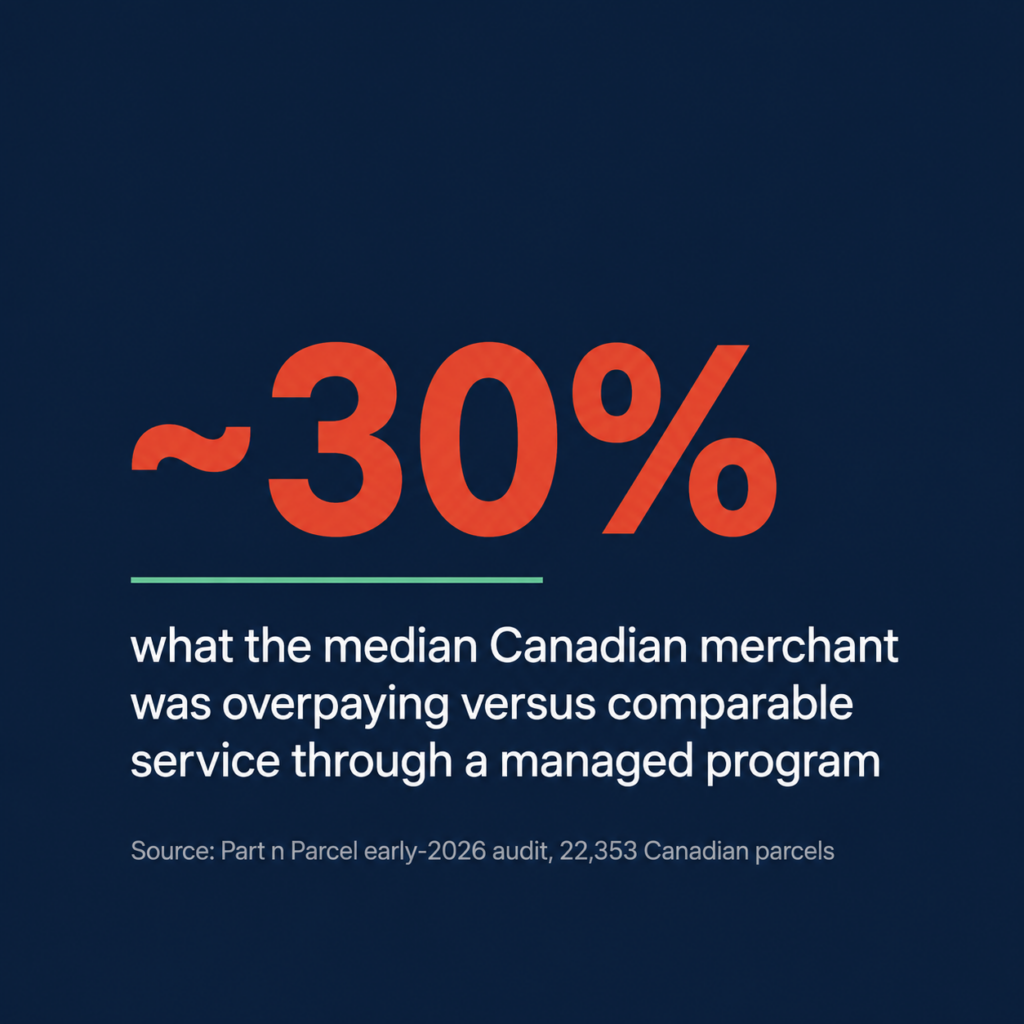
In our audit of 22,353 domestic Canadian parcels from 11 merchants shipped between January and May 2026, the median merchant was paying about 30 percent more than comparable service through a managed program. For every parcel we put the merchant’s actual paid rate beside what that same parcel would have cost on a Part n Parcel managed account, excluding taxes and duties. The full dataset is in our Canadian e-commerce shipping cost benchmarks report. On the platform side specifically, from the invoices we review, the markup spread often appears to land in the 15 to 25 percent range, and it stays invisible because it is inside a rate you never see broken out.
As an illustration, a $4.81 per-parcel gap at 100 parcels per shipping day over 250 shipping days totals $120,250 per year. Actual savings depend on the merchant’s shipments and rates. Recent examples, with each business’s cost cut and implementation time:
- A Toronto tea brand cut cut 25.4 percent by adding FleetOptics for local GTA deliveries alongside its existing FedEx, Purolator, Canpar and Canada Post mix, implemented in 7 days.
- An Ottawa apparel brand cut 18.3 percent by moving off Canada Post on Shopify to FedEx and Canpar, implemented in 10 days.
- A Toronto baby and kids brand cut 15 percent by moving from UPS to Canpar, implemented in 7 days.
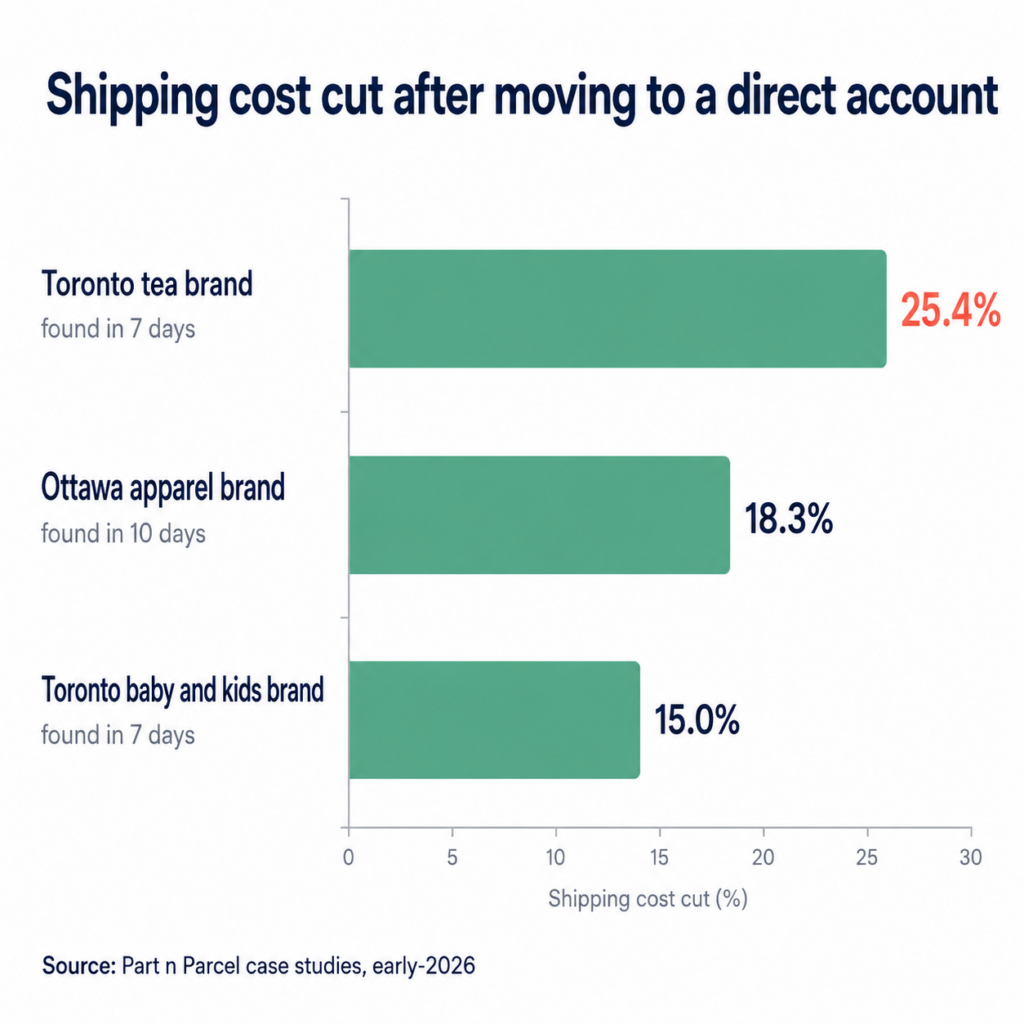
Each of those businesses moved onto a direct account in its own name with the markup in plain view, rather than onto a cheaper platform. The number usually improves after setup, as the routing gets tuned. There are more of these in the case studies.
How Do You Switch Without Disrupting Your Shipping?
You picture your whole shipping setup down for a week in the middle of your busiest season. It is one of the biggest reasons merchants stay somewhere they have already outgrown.
To find out whether moving is worth it, you send one invoice. We read it line by line and send back exactly where you are overpaying, by route, by weight, by carrier, by surcharge. Written analysis back to you, no call required. If the difference is small, you stay where you are and you have lost nothing but an email. If it is not, you will know what a direct account is worth before you change anything.
Frequently Asked Questions
- Are Chit Chats and Stallion Express bad? No. They are priced and built for lower-volume shippers, and while shipping isn’t yet a meaningful cost line, that simplicity makes sense. The ceiling appears the moment it becomes one.
- Is Part n Parcel just another shipping platform? No. Part n Parcel is a managed shipping economics company for Canadian e-commerce merchants. We open direct carrier accounts in your business’s name, source enterprise rates through a managed carrier network, configure the shipping workflow, and take a markup on carrier spend that you see before you commit rather than margin hidden inside the label price.
- When should I leave Chit Chats or Stallion Express? Check whether your current plan gives you the support, pickup options, volume pricing and routing flexibility your business needs. If it does not, compare a managed direct-account setup on total cost and service.
- Can I negotiate my own carrier rates in Canada? Often yes, and sooner than platforms suggest. Pricing and account support depend on the carrier, shipment profile and agreement. Collective volume can improve negotiating leverage.
- What’s the difference between a shipping platform and a direct carrier account? On a platform you ship under the platform’s account and its pricing, which it marks up and can change without telling you. With a direct account in your business’s name under a managed program, you see the carrier’s rate, the markup is quoted before you commit, and the carrier deals with you directly on service and claims.
- What about the other Canadian shipping platforms? netParcel, eShipper, Freightcom and ClickShip can all be useful, especially if you want courier comparison, discounted labels, pickups, freight, or broader carrier access than a drop-off platform gives you. They are still platform pricing on a platform account. Which one has the cheapest label today matters less than who sets the price, who holds the carrier relationship, who controls the routing, and who owns the claim when something goes wrong. Switching platforms changes whose account your parcels ride on. It does not put an account in your business’s name.
- Do I ship enough to get enterprise rates? If you are shipping 50 or more orders a day, you are past the point where this is worth checking. Send one invoice and see the number.
Every Unaudited Invoice Is Margin You’re Giving Away
The platform you started on was built for a smaller version of your business. At 50 or more orders a day, the markup you cannot see costs more than the convenience saves you. A single invoice will show you exactly how much, without a call to sit through or a switch to make.