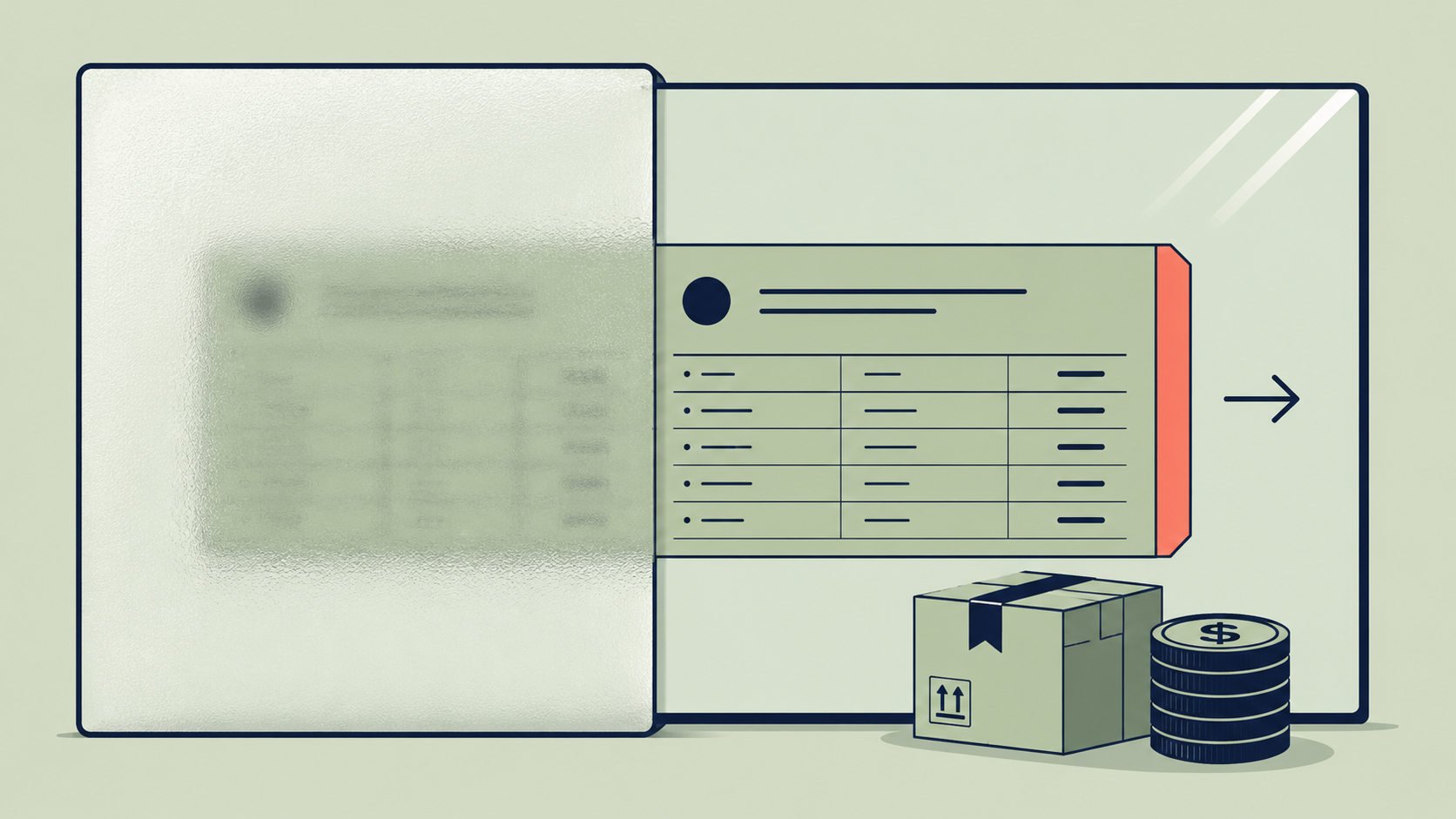
Yes, your carrier rate is negotiable. Most Canadian small businesses still pay too much because the only number they negotiate is the base discount, the percentage taken off the carrier’s standard rates. Everything billed on top of it goes untouched.
Merchants almost always forget something when they sit down with a carrier, and it is usually the same handful of items: the general rate increase, pickup fees, the dimensional weight factor, peak season surcharges, and fuel. Those five show up on nearly every invoice we read, and together they usually cost more than the base discount saves.
At Part n Parcel we read merchant invoices every week across 240+ Canadian e-commerce businesses shipping on FedEx, UPS, Canpar, and Purolator. The typical business we audit is overpaying by around 30 percent.
Most merchants assume volume is what sets their parcel rate. The bigger factor is who represents the account inside the carrier. As we’ve said before, “you’re not too small to get a great rate, you’re too small to get a great rep.” This guide walks through the playbook for negotiating a Canadian parcel bill, where each tactic stops working, and why whoever’s name is on the carrier account ends up holding the pricing power.
The advice below applies to small-parcel and courier rates. Those are the Canada Post, Purolator, UPS, FedEx, NationEx, GLS, and Canpar shipments that make up most e-commerce orders. Some businesses spend more on freight, meaning goods that move on pallets through trucking companies instead of as individual parcels. Freight runs on different carriers and a different rate structure, and none of what follows applies to it.
Are Canadian carrier rates actually negotiable?
Yes, but only inside the tier the carrier has already placed you in. Carriers sort every account by annual spend. The largest accounts get a named sales rep with the authority to change pricing. Smaller accounts land in the self-serve tier instead: a portal login, a standard published discount, and a general customer service line, with no one assigned to the account who can approve a better rate. You can still negotiate inside the self-serve tier, and you should, but you’re negotiating with someone who has limited room to say yes, on an account nobody at the carrier is paid to fight for.
That matters because carriers publish list rates, but the negotiated rate on an account is generally private. Every merchant negotiates their own rate card with no way to compare it against anyone else’s. Two businesses shipping the same volume on the same routes can land on very different prices and never find out.
That is rate opacity, and it works against Canadian merchants. When nobody can see what anyone else pays, the side with the full picture wins, and that side is the carrier.
The tactics below still work. Just go in knowing they route through a rep you didn’t choose, and that the carrier can see every other merchant’s rate while you can see only your own.
The Canadian parcel rate negotiation playbook
Work these in order, and bring clean data to every step. Vague asks get vague answers. Specific numbers, pulled from your own invoices, are what move a carrier.
Pull your full surcharge and accessorial history first
Before you ask for anything, request a historical accessorial and surcharge report from your carrier covering at least the last 12 months. Most merchants chase the base discount and never look at this. The report shows which fees recur on your account and how much they add up to. You can’t negotiate a fee you haven’t measured, and on most invoices we review, these recurring fees add up to more than the base discount itself.
Challenge dimensional weight and the carrier’s dim factor
Carriers bill on actual weight or dimensional weight, whichever is greater. Dimensional weight is calculated from the package’s size divided by a number the carrier sets, called a dim factor. For light, bulky parcels, like apparel or anything shipped in a large box, the dimensional weight can be several times the actual weight, so you end up paying for the space the box takes up, not what’s inside it. Ask what dim factor your account uses, push for a more favourable one, and right-size your packaging. Getting this right affects every shipment in that product category, not just one order.
Negotiate the accessorials, not just the base discount
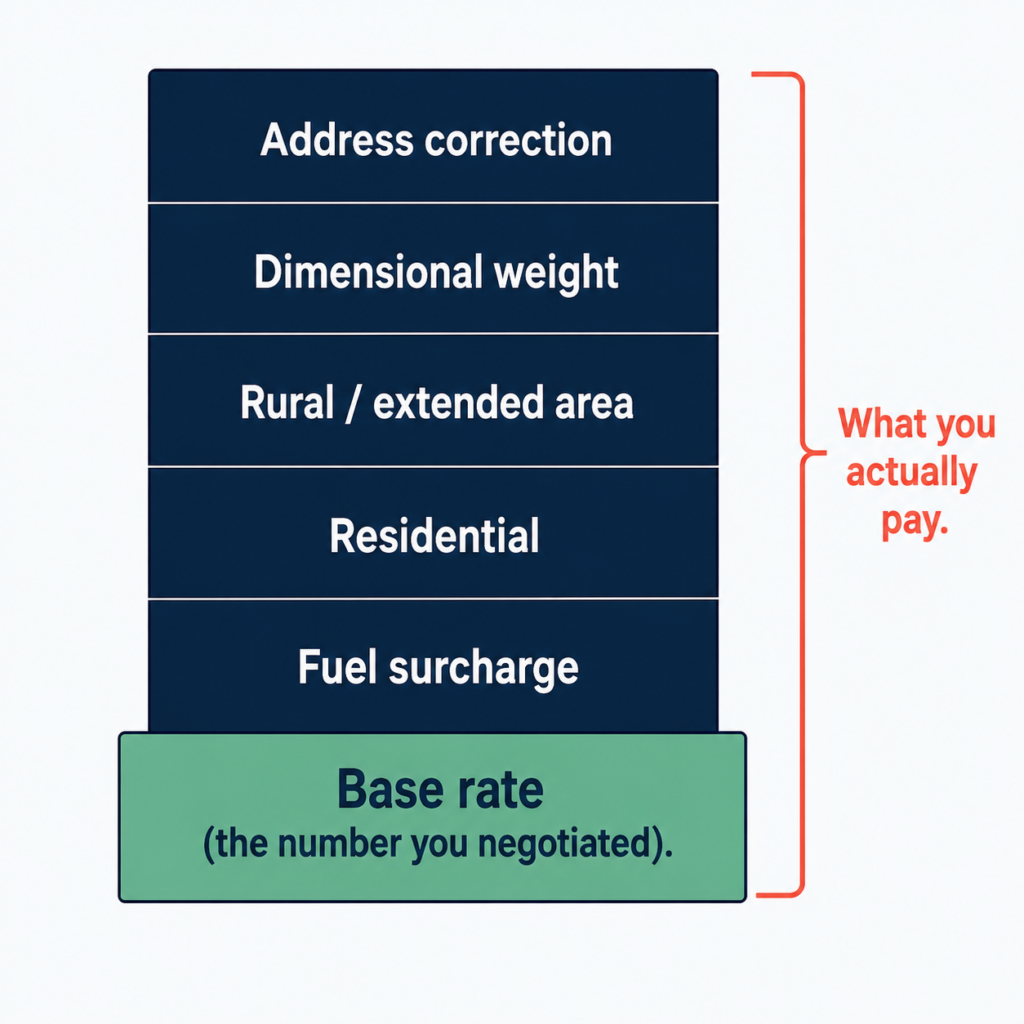
A base-rate discount does not remove accessorial fees. Residential fees, peak fees, address corrections and the annual increase are charged separately, and the base discount leaves them where they are. Fuel works differently, because carriers calculate it on the net transportation charge, so it falls when the base falls. FedEx Canada states its fuel surcharge is assessed on the net shipment rate plus applicable transportation-related surcharges. Compare the net transportation charge, the fuel calculation and each applicable fee. For most merchants those charges cost more over a year than the base discount saves. Pull each fee apart and negotiate it directly. The table below breaks down where a Canadian parcel bill grows beyond the number you negotiated.
| Charge | What it is | What to negotiate |
| Fuel surcharge | A floating percentage applied to every shipment, recalculated weekly or monthly | Calculated on your net transportation charge, so a lower base rate lowers the fuel dollars too, though the percentage itself moves weekly. Ask how it’s calculated and whether it can be capped. |
| Residential / home-address | A per-parcel fee for delivery to a home rather than a business | Most e-commerce orders go to homes, so this hits nearly every shipment. Ask for a reduction or a waiver. |
| Rural / extended-area | A surcharge for delivery outside core urban zones | A high spend here is often a sign your carrier doesn’t own coverage in that region and another carrier does. |
| Dimensional weight | Cost driven by package size, not actual weight | Negotiate the dim factor and fix your packaging. |
| Pickup fees | A recurring charge for the carrier collecting from your location | Frequently missed entirely. Ask whether it can be reduced or folded into your agreement at your shipment volume. |
| Address correction | A flat fee charged when an address needs fixing | Clean your address data at checkout to cut the volume, then ask for the per-item fee to be reduced. |
| Peak Fee | Fees that occur during certain times of the year when it gets busy (i.e. Holiday Season) | Talk about this when you set up your agreement and try to get it waived or capped so you are ready for your busiest time of year. |
| Annual rate increase | The general rate increase applied every year | Negotiate a cap. See below. |
Lock in a cap on the annual increase
Every major Canadian carrier raises rates each year, and the 2026 headline figures sit near 6 percent. FedEx and UPS have both announced average general rate increases of 5.9 percent for 2026, and Purolator’s most recent adjustment came in around 5.7 percent. You can see the full detail in FedEx Canada’s rate changes and UPS Canada’s rate and service guide.
The number a merchant feels usually runs higher than the headline, because home-address, rural, oversize, and signature fees often rise on the same day. That increase rides on top of your rate every month and compounds the next year on a higher base.
There’s no way to make the annual increase disappear, but you can negotiate a cap, a limit on how much your rate is allowed to rise per year, sometimes called rate-increase protection. A two-year cap can be worth more over its life than almost any headline discount, because it stops the compounding before it starts. It’s also the kind of term only a rep with authority will put in writing. In the self-serve tier, nobody negotiates that down for you, so you absorb the full increase every year.
Use multi-carrier leverage and lane-by-lane data
No single carrier is strong on every lane, the term carriers use for a specific origin-to-destination route. A 2024 ShipMatrix benchmark of intra-Canada transit times found Purolator fastest overall, with Purolator Express also leading on rural deliveries, while UPS lagged both Purolator and FedEx on speed. If you’re locked into one carrier, you overpay, or wait longer, on every lane that carrier is weak on, with no leverage to change it. Pull your shipments apart by lane and price each one against an alternative carrier. That lane-by-lane data is also your strongest negotiating asset, because it proves exactly where a carrier is losing your business. Our guide on how to benchmark Canada Post vs UPS vs FedEx vs local carriers’ rates walks through the comparison.
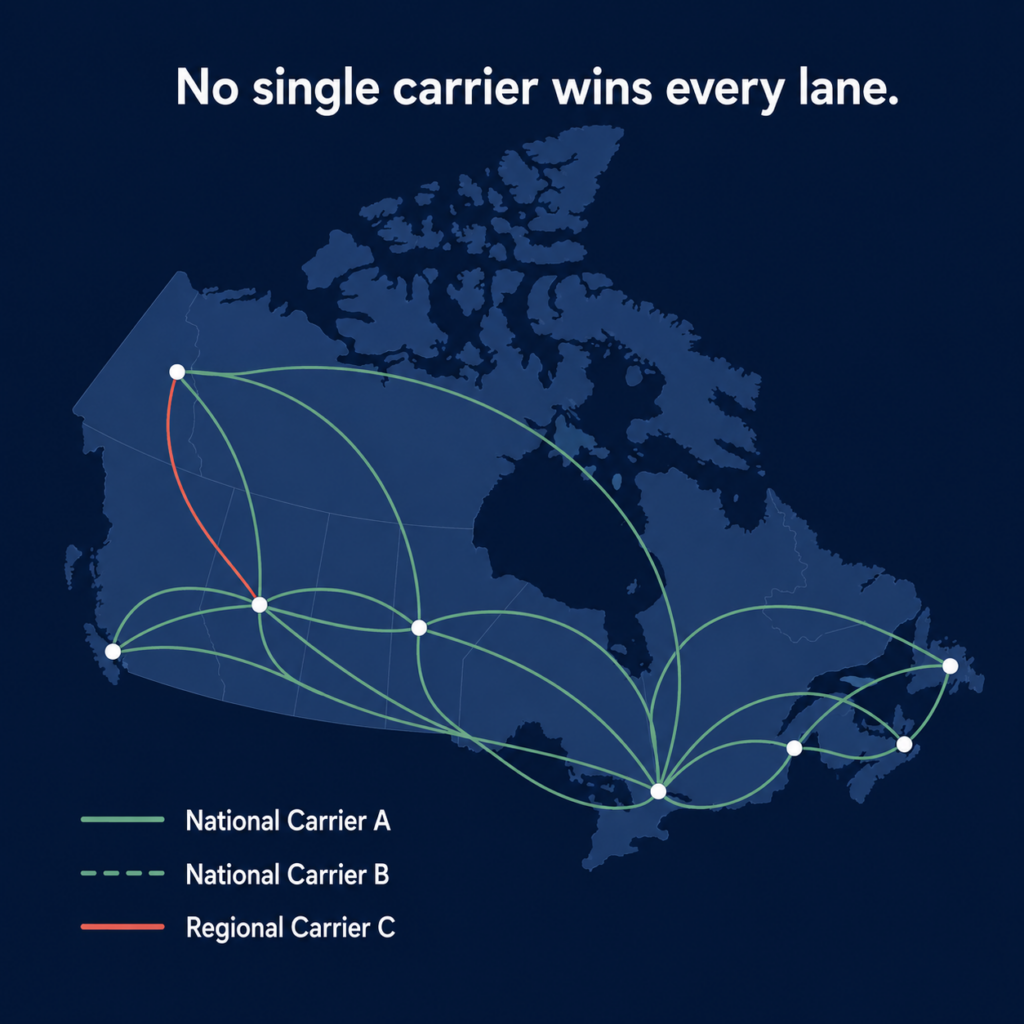
Splitting carriers by lane instead of committing to one is where the biggest savings show up. A Vancouver luxury fashion brand was running everything through UPS alone, with rising rates and no alternative to price against. After moving to a Canpar, Purolator, and FedEx mix routed by destination, they cut total shipping costs by 57 percent. A Toronto tea company cut 25.4 percent the same way. It split volume across FedEx, Purolator, Canpar, and the regional carrier FleetOptics, putting FleetOptics on the local routes where a regional network beats a national one. The breakdown is in our Canadian tea case study.
Time the conversation and bring clean numbers
When you ask matters. The strongest moments are off-peak (not during the Q4 crush), at your annual renewal, and right before a planned volume increase you can document. Walk in with your accessorial report, your lane data, and a specific target. A carrier moves for a merchant who clearly knows their own numbers and has a competing option. It doesn’t move for “can you do better.”
Know the volume math before you walk in
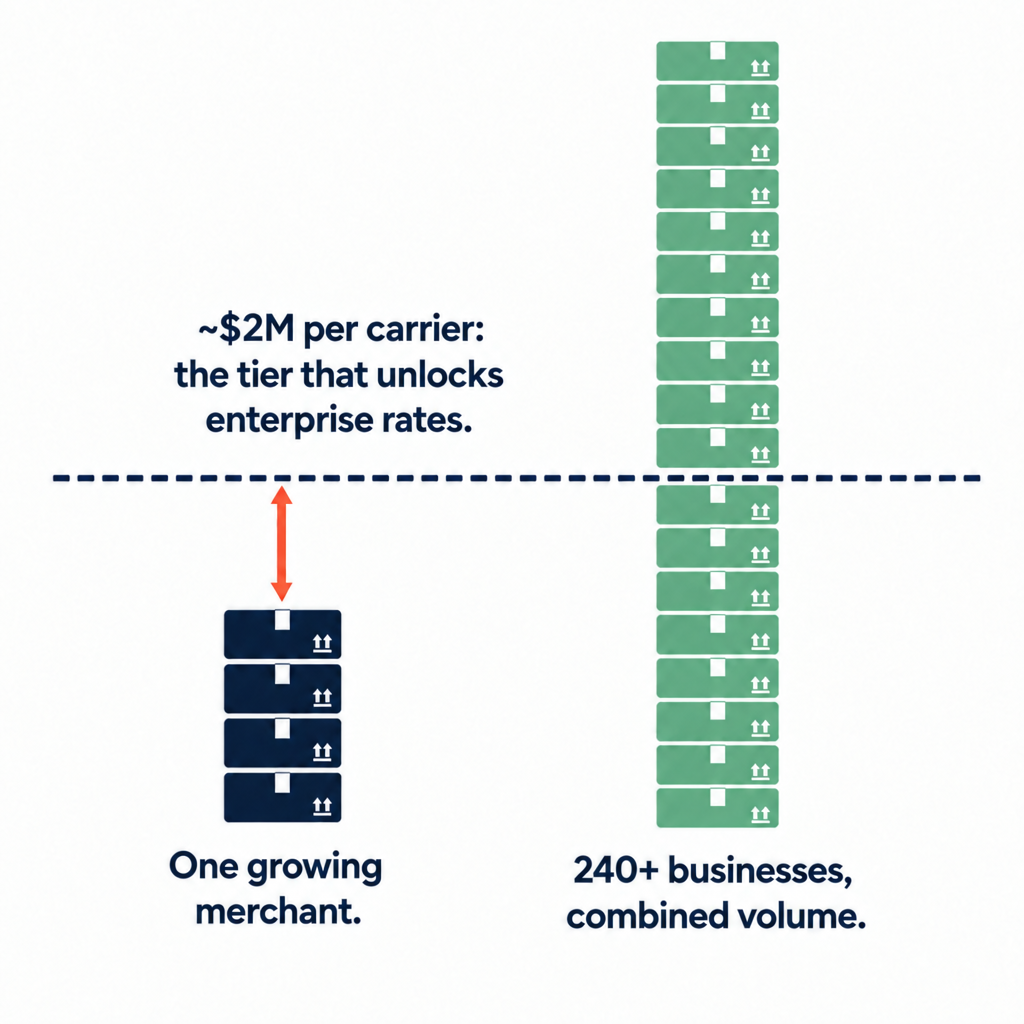
Be honest with yourself about leverage. Meaningful single-carrier negotiating power starts at roughly $2 million in annual spend with that one carrier. The math is per carrier, not total. A merchant shipping $3 million a year split across three carriers is at about $1 million each, which still isn’t enough for a named rep, a custom rate card, or pricing authority. This is why a large merchant can run a clean negotiation and still get the self-serve answer. The volume that unlocks the good tier is concentrated, and a single growing business almost never has it on any one carrier.
Why a perfect negotiation still isn’t enough
Run every tactic above flawlessly and you’ll still run into two problems a small merchant can’t solve alone.
The first problem is the rep. Carriers assign representatives by territory, so you belong to whoever owns yours. You can’t shop for a better one, you can’t request the sharp rep your competitor has, and you have no say in who inherits your account when yours moves on. Reps turn over with no notice and no handoff. One merchant told us they went looking for their Canada Post small-business rep and got an email bounce-back, the rep apparently retired with no replacement. It’s one story, and we treat it as that, but the pattern behind it is common. The relationship you spend a year building can reset to zero.
A good rep does several concrete things a self-serve account never gets:
- Gets you into a better pricing tier, and defends it when your volume dips.
- Knows which fees the carrier will waive on request and which ones it won’t.
- Builds the internal case, in the carrier’s own language, to get pricing approved that you’d never get by asking cold.
- Acts as your advocate, because carrier pricing rarely improves on its own for an account no one inside is championing.
On your own, you don’t control who gets assigned to your account, when they leave, or who picks it up next.
The second problem is information. The carrier has run thousands of these negotiations and knows where your rate sits against every other merchant in the country. You’ve run one, staring at a single contract with no reference point. When one side can see every other merchant’s rate and the other is guessing, the guessing side loses. That’s how the market is built. It rewards staying put and works against the merchant who can’t see what everyone else pays.
What about a shipping aggregator that hands you a rep?
The obvious next move is a shipping aggregator that gives you a rep on day one. If shipping isn’t yet a meaningful cost line, that simplicity makes sense.
That works until shipping becomes a competitive line item. On an aggregator, the account sits in the platform’s name, not yours. The carrier doesn’t know you exist. The rate you pay is the wholesale rate the platform negotiated plus a margin it sets, and that margin is invisible. There’s no published rate card to check it against, and the platform can change it without telling you. Past a certain volume, that usually costs a merchant more than a direct agreement would.
The aggregator solves the problem of reaching a rep. In exchange, you lose the ability to see your own rate. This is structural, not a knock on any one platform. An aggregator earns on that spread, which is why it can never compete on transparency without exposing every markup it’s ever charged.
Moving off platform rates and onto direct accounts is where that spread turns back into savings. An Ottawa apparel brand selling both direct-to-consumer and wholesale had been shipping on a third-party platform ‘s rates rather than its own carrier contracts. After moving onto direct FedEx, Canpar, and Purolator accounts in its own name, it cut shipping spend by 42.5 percent, a result detailed in our Canadian apparel case study. A gardening business shipping out of St. John’s had been expanding nationally on public platform rates while losing margin on every remote lane. After moving to direct commercial contracts with Canpar, Purolator, and UPS, it cut shipping costs by 41.6 percent, detailed in our Canadian gardening case study.
Put the carrier account in your own name
Every tactic and every problem above comes back to the same point: the moment you don’t own the carrier account, you’ve outsourced pricing power. What you want instead is a direct carrier account in your own name, with the rep relationship and the volume a single business can’t assemble on its own.
Here’s how that works without pretending to be bigger than you are. Part n Parcel has spent a decade building relationships with reps across every major Canadian carrier, on behalf of a whole network of merchants, and those relationships compounded. Our network agreement aggregates the volume of 240+ Canadian e-commerce businesses to more than clear the roughly $2 million per-carrier threshold that unlocks enterprise rates, a threshold a single merchant can’t reach alone. Your carrier accounts stay in your name, so the carrier still handles carrier problems directly. The enterprise rates come from the network’s combined volume, and they’re tied to that network agreement, not portable terms you take with you if you leave.
Part n Parcel earns on shipping too, through a transparent markup you can see before you commit, not a hidden spread on every label. That visible markup is the difference from an aggregator, which buys wholesale and adds a margin you never see. The account is yours, and the rate on it is your carrier rate.
| Shipping aggregator | Self-managed | Part n Parcel | |
| Pricing | Marked up, margin hidden | Negotiated, then static | Enterprise rates, transparent markup |
| Carrier support | Filtered through the platform | Direct with the carrier | Direct with the carrier, plus our intelligence |
| Ongoing optimization | Set and forget | None, or your own time | Continuous and managed |
| Whose name the account is in | The platform’s | Yours | Yours |
A direct account with us delivers what a negotiation alone can’t: the rep who can move a tier, the case-building the carrier will approve, and someone defending the rate after it’s signed. Most businesses in the network land between 15 and 40 percent below what they were paying. The right combination of volume, carrier mix, and destinations can push that further, as the 57 percent and 42.5 percent results above show, but those are specific situations, not a promise. You can see the full range in our shipping solutions for Canadian e-commerce.
Check these four things on your next invoice
You don’t need us to start. Pull your most recent carrier invoice and answer these four questions.
- Do you have a named rep you can reach, or just a login and a phone line?
- What is the gap between your base charge and your total bill after every fee?
- Did anyone cap your annual rate increase, or are you absorbing it in full every year?
- Are you paying residential, rural, or extended-area fees on the orders that make up most of your volume?
If you can’t answer these, you don’t have clear visibility into what you’re paying, and merchants who can’t see their costs are almost always overpaying. The cost of not knowing shows up on every invoice.
See what your current setup is costing you
The tactics in this guide will move your bill. What they can’t change is the rep you can’t keep and the rate you can’t see. A direct account in your own name changes both.
Every unaudited invoice is margin you’re giving away. Send us your recent invoices and we’ll show you the difference between what you’re paying and what you should be paying, and exactly what your current setup is costing you.