Shipping is expensive in Canada for reasons that go well beyond geography. Yes, carriers cover enormous distances to reach a thinly spread population, and that sets a high floor. But the charges that keep climbing after you sign a deal have nothing to do with distance. Carriers negotiate every rate privately, so no merchant can benchmark what they pay. They stack floating surcharges on top of your base rate that no discount touches. And most merchants ship through a single carrier or platform, so they never see the cheaper route sitting one carrier over.
At Part n Parcel, we analyzed 22,353 real parcels shipped by Canadian e-commerce merchants in early 2026 and found the typical merchant was overpaying by roughly 30%. That gap almost always comes down to the same thing. If you do not hold a direct carrier account in your name, you have handed pricing power to the party that already reads your bill better than you do.
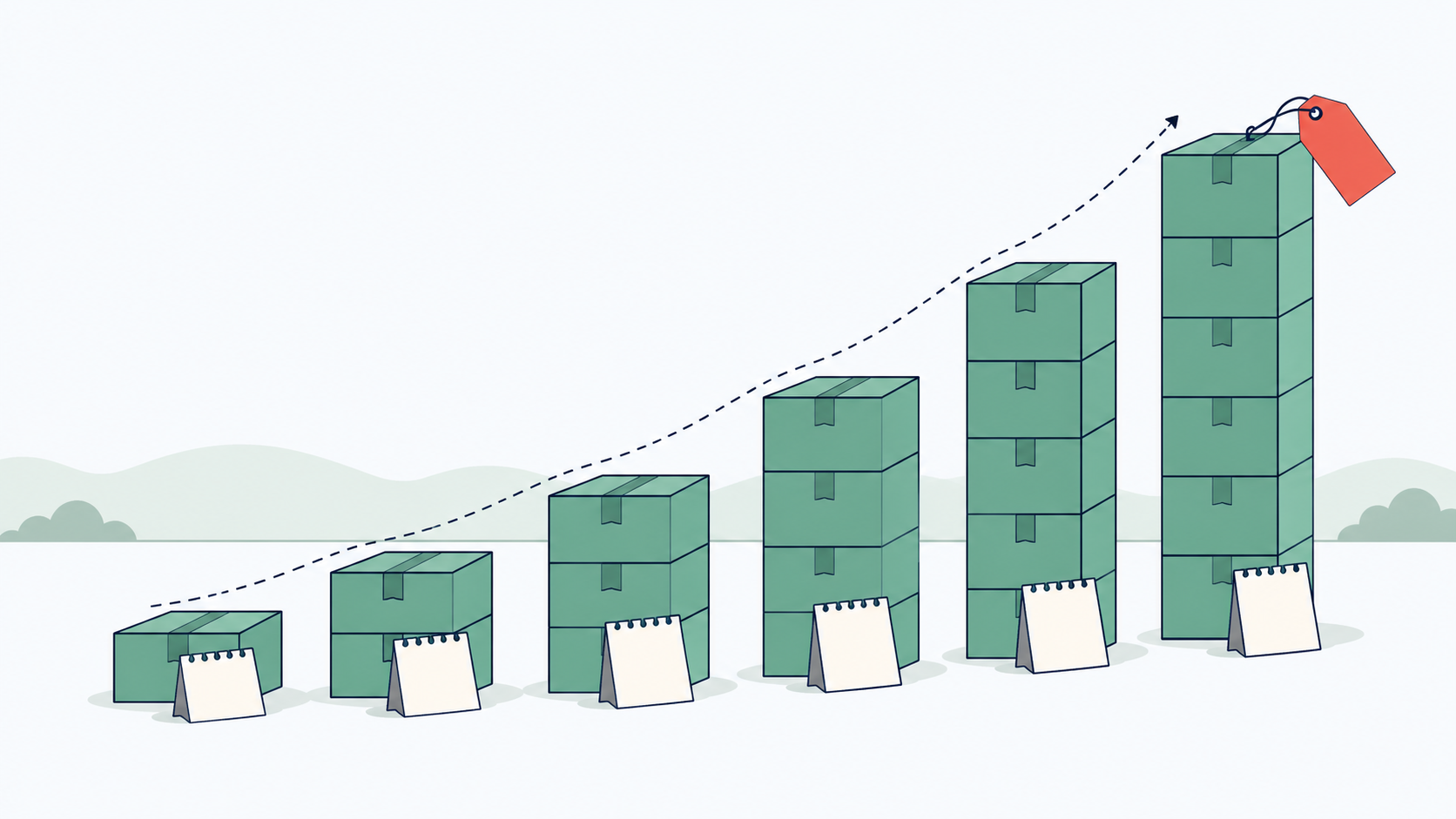
Geography explains why Canadian rates start high. It does not explain why your bill keeps climbing months after you signed a deal that looked great. We manage shipping economics for 240+ Canadian e-commerce businesses, and the pattern is the same almost every time. The discount stays put while everything stacked on top quietly moves, and the merchant has no reference point to catch it.
Why does shipping cost so much in Canada?
Five factors drive the cost of shipping in Canada, and only one of them is geography.
- Carrier networks cover enormous distances to reach a population spread thin across the second-largest country on earth.
- Carriers do not publish the rates that matter. Every merchant negotiates privately, with no way to compare.
- Surcharges float and stack on top of your base rate, so the bill moves even when your discount does not.
- Remote and rural postal codes carry separate delivery fees that base discounts never cover.
- Most merchants are locked into one carrier or one platform, so they never see better routing options.
The order matters. Geography sets the floor. The rest of the stack is where the real money leaks, and it happens to be the part you can actually fix.
Does geography really make Canadian shipping expensive?
Yes, but only at the starting line. Canada covers 8,788,702.8 square kilometres with a population density of about 4.2 people per square kilometre, according to Statistics Canada’s 2021 Census geography data. Roughly 17.8% of Canadians live in rural areas, and the three territories alone make up 39.1% of the landmass and just 0.3% of the population.
That spread means fewer parcels per stop, longer line-haul distances, and expensive service to remote postal codes. Carriers price for it directly. When Canada Post restructured parcel pricing in 2025, it expanded its rate codes from 45 to 128 to better reflect local, regional, national, urban, and rural differences, per its 2025 parcel pricing notice.
So geography is a real contributing factor, and it is baked into the tariff. But it is a fixed condition. It explains why your rates were high the day you started. It does not explain why the same package on the same lane costs more this quarter than it did last year, when your discount never changed. For that, you have to look at how the bill gets built.
Why do my shipping rates keep going up if my discount stayed the same?
Because the discount and the bill are two different things. Your negotiated discount sits on the base rate and rarely moves. Everything stacked on top of that base rate moves constantly, and almost none of it is discounted. The climb happens through several layers at once.
- Fuel surcharge. This floats as a percentage on top of your base rate and adjusts weekly. FedEx Canada’s intra-Canada fuel surcharge ran from 21.50% to 53.50% depending on the diesel price band as of April 2026, per its fuel surcharge page. Canada Post’s domestic fuel surcharge was 37.50% for the week of June 1 to 7, 2026. Because fuel is a percentage of the base, even your discounted shipments quietly cost more every time diesel moves.
- The annual general rate increase (GRI). Carriers raise list rates each year, and the increase hits different lanes and weight bands by different amounts. Two identical packages going to two destinations can come out of an annual increase priced differently.
- Peak and demand surcharges. These switch on during the busiest months, exactly when you ship the most, and no negotiated discount removes them. For the 2025 holiday season carrying into early 2026, Canada Post raised its oversize surcharge to $30 from $21 and its out-of-spec surcharge to $400 from $300.
- Residential delivery surcharges. FedEx applies a $4.80 residential delivery surcharge per intra-Canada shipment, and most of your e-commerce orders go to homes.
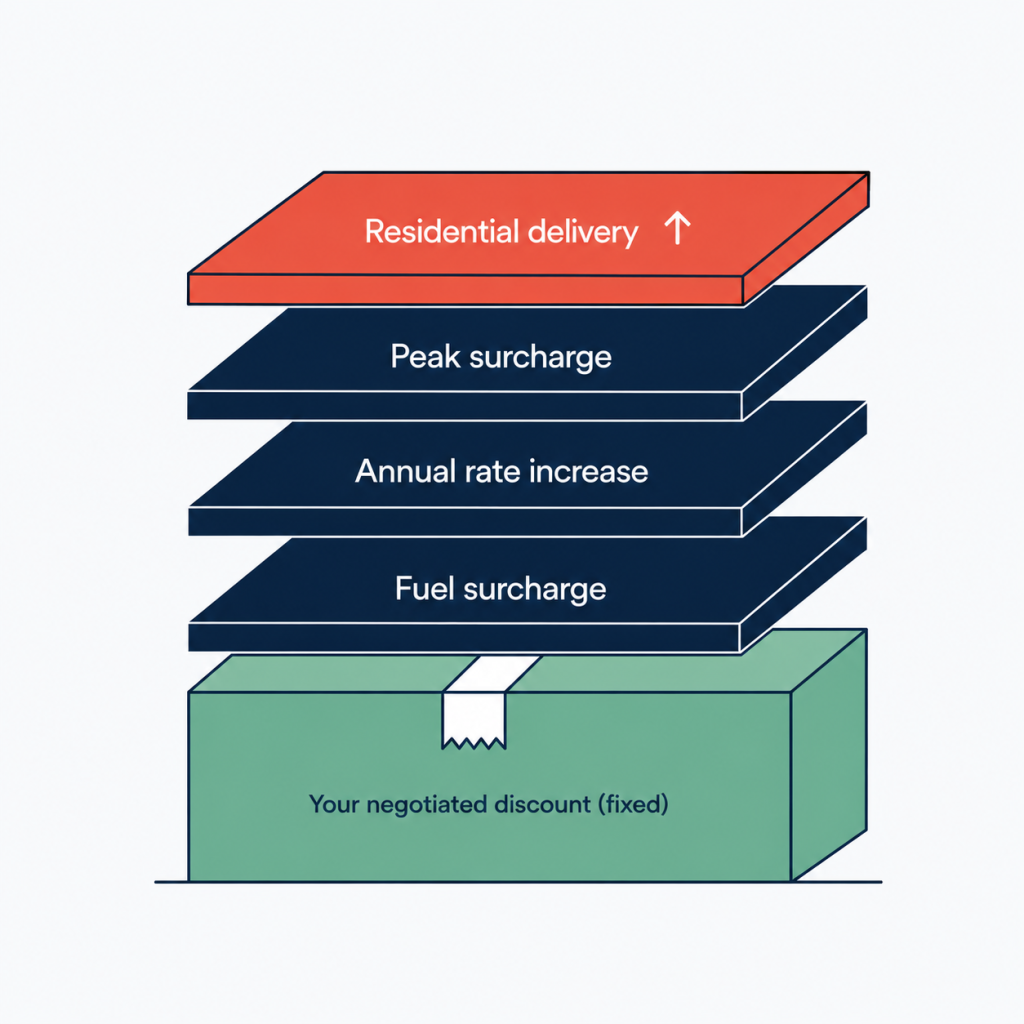
The floating charges also compound the fixed ones. UPS Canada states that its fuel surcharge applies not just to transportation but also to extended area charges, residential delivery, additional handling, large package surcharges, and peak surcharges, per its fuel surcharge page. FedEx assesses fuel on the net rate plus those transportation-related surcharges too. So the discount you negotiated keeps doing exactly what it was meant to do on the base rate, while the surcharges stacked above it climb on their own. Your deal is intact. The carrier earns its margin back through the levers, not by touching the discount you were watching.
For a line-by-line breakdown of which charges climbed and by how much, see our companion guide on how to reduce shipping costs for Canadian e-commerce.
Send us your invoice and we’ll show you what you’re actually paying.
Why can’t I tell if I’m overpaying for shipping?
Most of the time, you can’t, and that is by design. Every shipping cost analysis problem traces back to one mechanism: carriers publish list rates, but the rates that actually decide your bill are private. Canada Post’s own business price guide separates public business prices from contract prices that require a sales agreement, and FedEx tells customers to check their individual shipping agreement to understand the true net effect of any published change.
So every merchant negotiates discounts, minimums, zones, and surcharge terms alone, with no reference point. Two shops shipping identical boxes on identical routes can pay completely different rates, and neither one will ever find out. In a market where buyers cannot compare true net pricing, the most informed party wins. That party is always the carrier. They run thousands of these negotiations a year. You run one every few years.
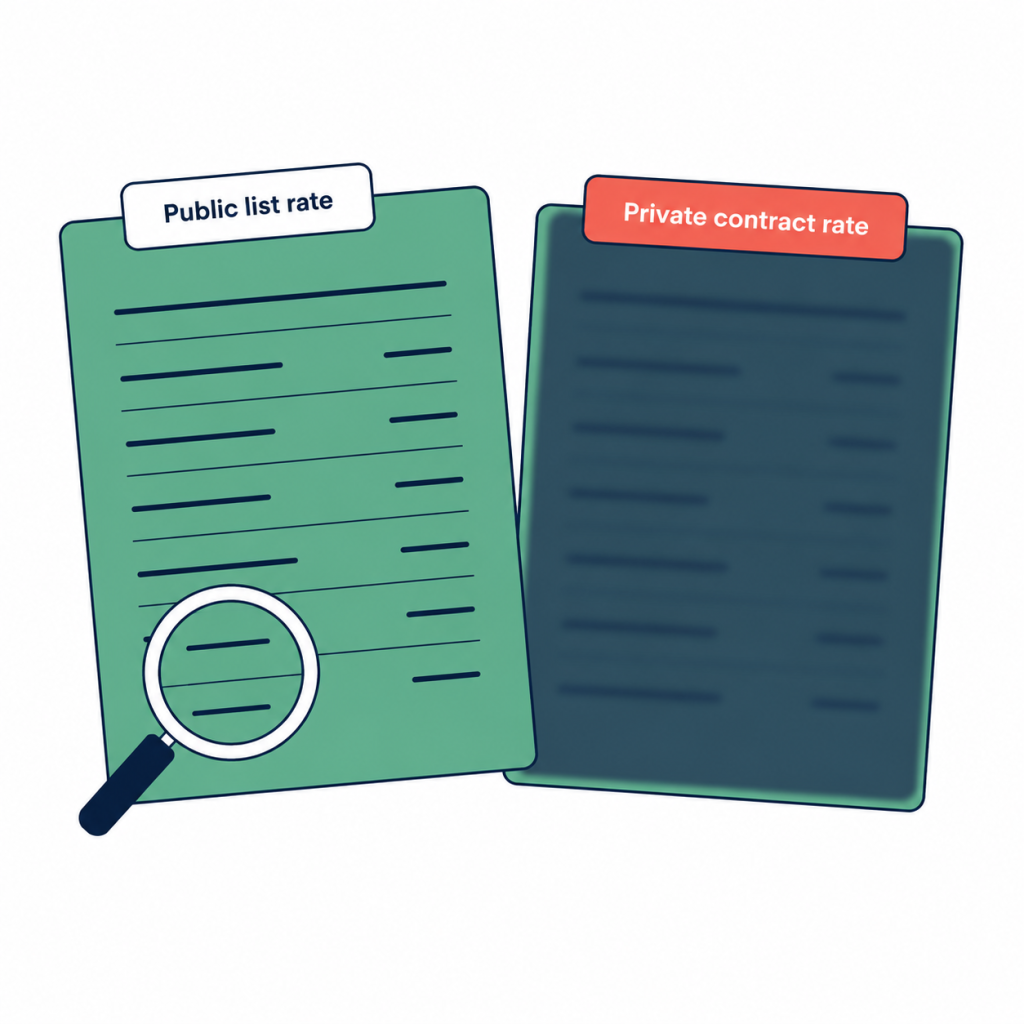
This is not a glitch, and it is not spite. It is the design. An unreadable price is a price you cannot tell is too high. The whole problem traces back to one fact: when the carrier reads your bill better than you do, you are negotiating against someone who already knows the answer.
If I don’t own the carrier account, who controls my pricing?
If the account is in your name, you do. If you ship on a reseller or platform account, they do. It comes down to two ways to ship.
- A direct carrier account in your name. You have a real relationship with the carrier, full visibility into your rate card, and access to enterprise service lines when something goes wrong.
- A reseller or platform account controlled by someone else. You ship on their pre-negotiated deal, with their margin built into a rate you cannot see, and the carrier does not know you exist.
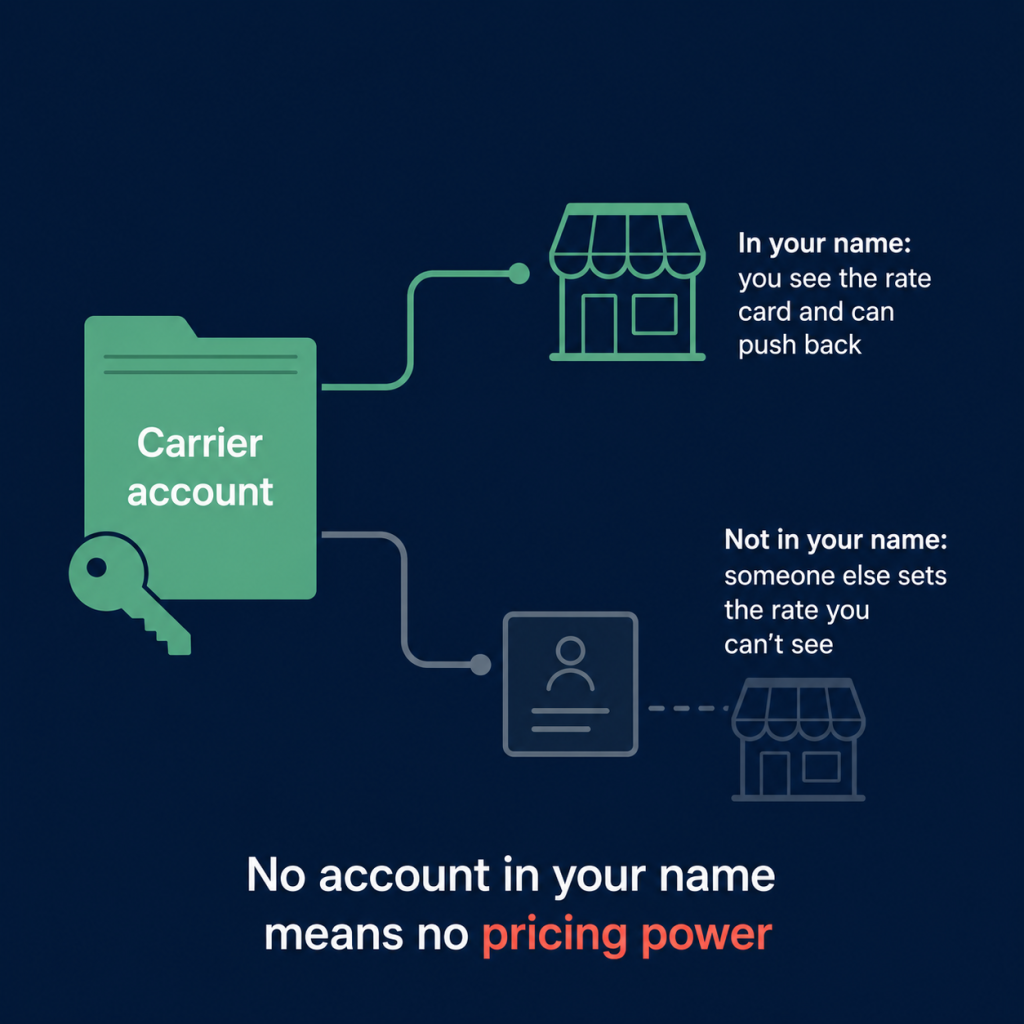
When you do not hold the direct account, you have outsourced your pricing power. You cannot audit a rate you are not allowed to see. You cannot escalate to a carrier that has no record of you. You take whatever the rate happens to be, with no standing to question it. Every other problem in this article gets worse on an account that is not yours, because you lose the one thing that lets you push back: visibility.
Why doesn’t switching carriers fix the problem?
Because switching is hard, and carriers price knowing that. Moving carriers means relearning a process, rescheduling pickups, rewiring your store and shipping software, and getting your team comfortable again. Annual increases are sized to land just under the point where you would bother to leave.
There is also a tier problem. Carriers sort customers by volume. The largest accounts get a dedicated representative who actively manages pricing. Small and mid-size merchants get the self-serve tier with a basic discount, a login, and not much else. Putting a real person on a smaller account does not pay off for the carrier, so they do not do it. Nothing personal. It is the math of their sales organization.
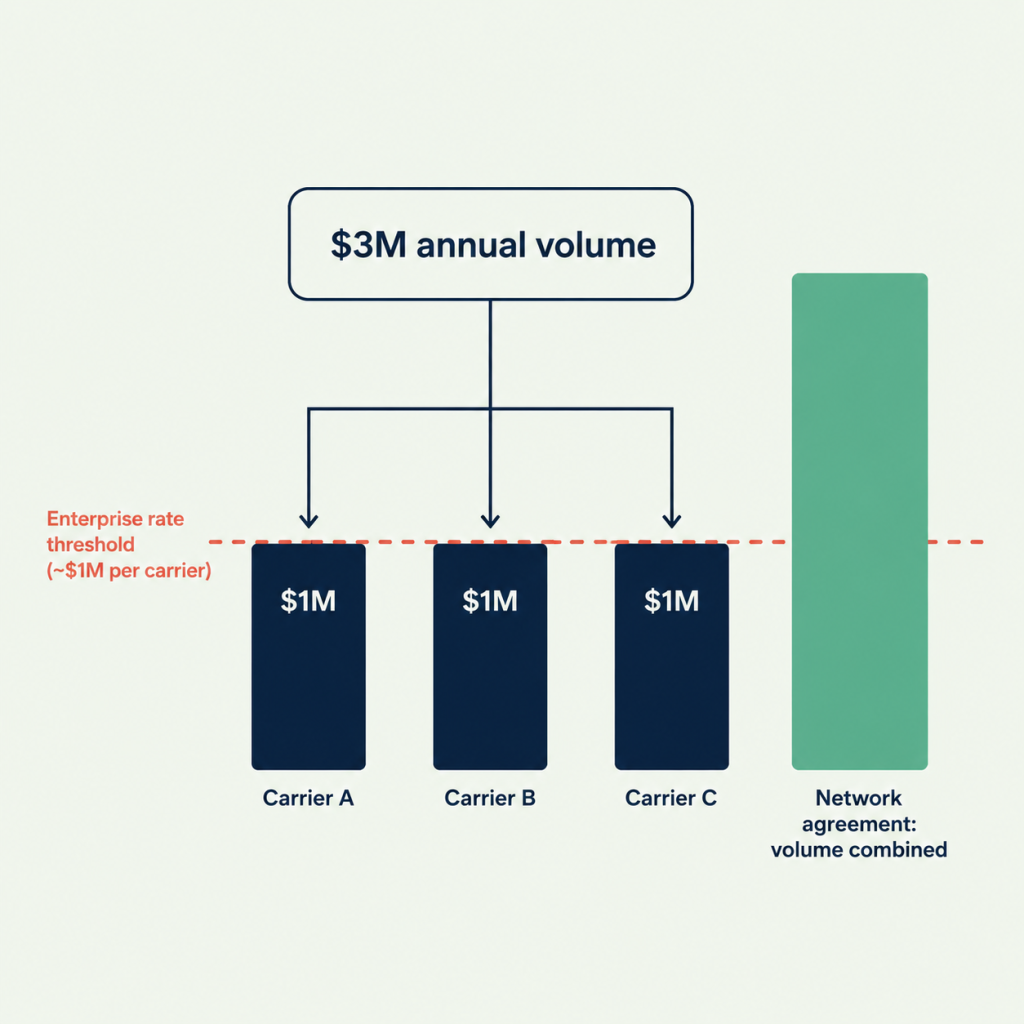
The volume math is where most Canadian merchants get stuck. Enterprise rate programs with any single carrier require roughly $2M in annual volume with that one carrier. A merchant shipping $3M a year split across three carriers is sitting at $1M each, and still lands in the self-serve tier with all three. The volume is there. It is just divided in a way that earns no leverage anywhere. This is the gap Part n Parcel was built to close. Our network agreement aggregates volume across 240+ Canadian e-commerce businesses, so an individual business qualifies for enterprise rates it could never reach splitting its own spend across carriers.
Isn’t shipping through a platform cheaper than a direct account?
Usually not, for two reasons most merchants never see. First, platforms get squeezed by the exact same carriers. Peak surcharge, GRI, and weekly fuel hit a platform’s master account the same way they hit yours. The platform sits inside the carrier system, not outside it. Second, the platform needs margin too, and that margin is built into the rate you see, with no published rate card to check it against.
There is an important distinction to keep straight here, because two different things often get called “the platform.”
| Shipping software | Reseller or aggregator | |
| What it does | Compares, automates, and manages shipments | Sells you its own pre-negotiated rates |
| Whose rates | Whatever carrier accounts you plug in | The reseller’s accounts, marked up |
| Carrier relationship | Yours, if you bring direct accounts | The reseller’s, never yours |
| Rate visibility | Full, on your own accounts | Hidden, with margin baked in |
Shipping software like ShipStation helps you compare and automate shipments using whatever carrier accounts and rates you connect to it. A reseller works differently. It sells you its own rates with the margin already inside them. Either way, the software is only as good as the carrier accounts and routing logic behind it, and that back end is the part most merchants never get help building. Optimization software does excellent work on the rates you feed it. It cannot fix rates that were never good to begin with. We fix the rates first, then let the software run on numbers that are actually real.
Why do I get charged extra for rural and remote deliveries?
Because no single carrier covers all of rural Canada on its own trucks. When a package goes off a carrier’s map, that carrier hands it off for the last stretch or charges a separate fee to reach it. These fees are not small. UPS Canada’s 2026 domestic delivery area surcharges run from $5.40 to $152.50 depending on how remote the postal code is, per its 2026 rate guide. FedEx applies a separate remote rural surcharge to Ground packages of $7.05, $17.80, or $150 per package depending on the destination postal code, plus another $42 on packages over 100 lb, per its 2026 Remote Rural Surcharge schedule.
The frustrating part is that those fees are not fixed costs of nature. They reflect one carrier lacking coverage in that area. A different carrier might deliver to the exact same address on its own truck with no surcharge at all, because for them it is a normal route. Locked to one carrier, you never see that option. Routing across carriers flips the picture entirely. Send the package to the carrier that owns coverage in that area and skip the handoff. The advantage is a better route, not a better discount.
Why does dimensional weight make my packages cost more?
Because carriers bill on the greater of actual weight or a calculated volumetric weight, so a light, bulky box gets charged as if it were heavy. Measurement Canada defines dimensional weight as a theoretical weight based on a minimum density factor, and confirms the charge is based on whichever is higher. Canada Post applies a density factor of 5,000 cm³/kg to most parcel services. Its own example shows that a 100 cm by 60 cm by 20 cm parcel weighing 8 kg bills as 24 kg under Xpresspost, three times its actual weight.
This is why low-density products feel overpriced no matter what discount you hold. It also means package design and routing matter before any rate negotiation even starts.
What is overpaying on shipping actually costing Canadian merchants?
Roughly 30% more than they need to pay, based on our early-2026 analysis of 22,353 real parcels across 11 Canadian merchants. The gap is widest on packages crossing provincial borders, where merchants are most likely to be locked into the wrong carrier for the lane.
The same shipments, billed as-is versus routed across the right carriers, looked like this.
| Route | What the merchant paid | Routed across carriers | Gap |
| Within one province | $13.62 | $9.28 | 32% |
| Crossing a provincial border | $28.02 | $12.80 | 54% |
| Ontario to New Brunswick | $32.28 | $15.39 | 52% |
| Ontario to British Columbia | $28.41 | $17.32 | 39% |
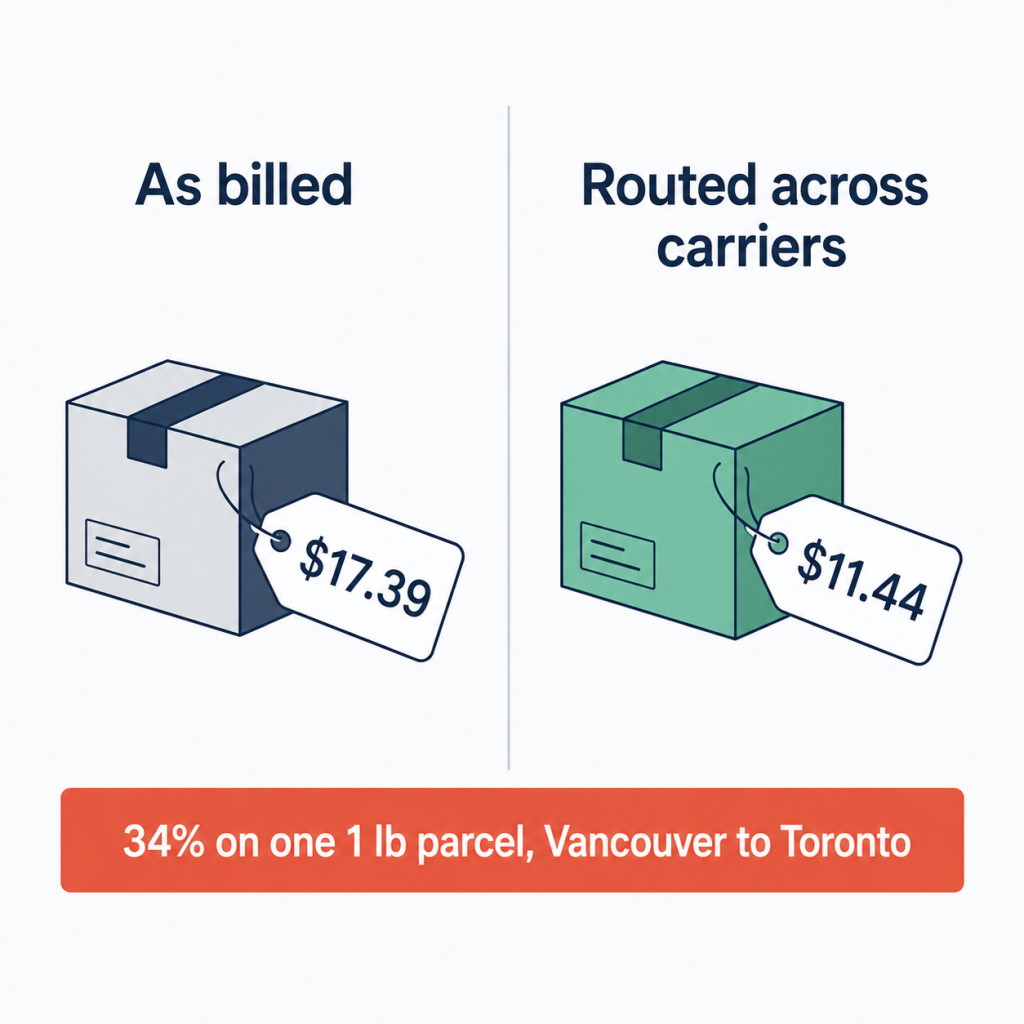
A 1 lb parcel from Vancouver to Toronto cost one merchant $17.39. Routed to the carrier that owned that lane, the same parcel cost $11.44. That is 34% on a single package, on a route the merchant ships every day.
Scaled up, the overpayment stops being a rounding error. At 50 orders a day, a 30% overpayment runs roughly $87,800 a year. At 100 orders a day, roughly $175,600 a year. Savings vary by weight, zone, carrier mix, address type, and your current contract, and most merchants land in a 15 to 40% range once routing is fixed. Results above that range happen, but they are upside, not the baseline.
We saw this play out with a Montreal healthcare retailer shipping on FedEx Express and Canada Post through standard small business accounts. They had the volume to grow nationally but not the volume to negotiate real rates with any one carrier alone. After moving to a managed multi-carrier mix with direct commercial accounts, including Purolator and Canpar for regional lanes and FedEx reserved for where it actually won, they cut total shipping costs by 40%. The full breakdown is in our Canadian healthcare shipping optimization case study.
How do Canadian e-commerce businesses actually reduce shipping costs?
The fix is not a better headline discount. It is two things working together. Seeing the whole number, and routing every package to the carrier that should have had it.
Seeing the whole number means holding direct carrier accounts in your name, with full visibility into the rate card, the surcharges, and the net cost per shipment. Routing every package correctly means maintaining an optimized mix across carriers and sending each parcel to the one that owns that lane, that weight band, and that postal code. Doing both continuously is real work. It means watching rate changes as they happen, understanding how GRI compounds, knowing which carrier performs in which corridor, and benchmarking your costs against what comparable merchants actually pay. For a deeper look at how the major carriers stack up, see our guide on how to benchmark Canada Post vs UPS vs FedEx vs local carrier rates.
That is the work Part n Parcel does for 240+ Canadian e-commerce businesses. We set up direct carrier accounts at enterprise rates through our network agreement, configure your shipping platform, build the routing rules, and monitor the accounts so the rates keep working in practice and not just on paper. You keep a direct account in your name. We make sure it stays the cheapest route on every lane. We earn a transparent markup you see before you commit, which is a different thing entirely from a margin hidden inside every label.
Frequently asked questions
Why is shipping more expensive in Canada than in the US?
Lower population density and longer distances. Canada has about 4.2 people per square kilometre spread across the world’s second-largest landmass, which means fewer parcels per stop and longer line-haul routes than a denser market like the US. That raises the cost floor before any discounting begins. The bigger controllable gap, in our experience, comes down to whether a merchant holds direct carrier accounts and routes across carriers, or ships on a single account that loses on half its lanes.
Why did my shipping rates go up even though my discount didn’t change?
Your discount applies to the base rate, which rarely moves. The charges stacked on top move constantly. Weekly fuel surcharges, the annual general rate increase, seasonal peak surcharges, and residential delivery fees all climb independently of your negotiated discount, and most are not discounted at all. The bill rises while the discount looks untouched.
Is shipping through a platform cheaper than having direct carrier accounts?
Usually not. Platforms pay the same carrier surcharges you would, and they add their own margin to the rate you see, with no rate card to check it against. Shipping software is genuinely useful for comparing and automating shipments, but it can only optimize the rates you feed it. Direct carrier accounts in your name give you the visibility and leverage a platform account cannot.
How can a Canadian e-commerce business reduce shipping costs?
Hold direct carrier accounts in your name, route every package to the carrier that performs best on that specific lane, and monitor your rates and surcharges continuously so increases get caught early. Merchants who fix routing and gain rate visibility typically land in a 15 to 40% savings range. Doing that continuously is the work Part n Parcel handles for 240+ Canadian merchants, so the leak gets caught on your own account instead of compounding quietly on someone else’s.
See what your current setup is actually costing you
Every invoice you do not audit is money leaving your business, and the gap between what you pay and what you should pay is almost always bigger than it looks on a single label.
✓ No long-term contracts. Pay-for-performance pricing, so you only pay once the savings are real.
✓ We review your actual invoices, not a generic average.
✓ Trusted by 240+ Canadian e-commerce businesses on direct carrier accounts.
Send us one recent invoice, and we will show you the gap on your real shipments, not a generic average.