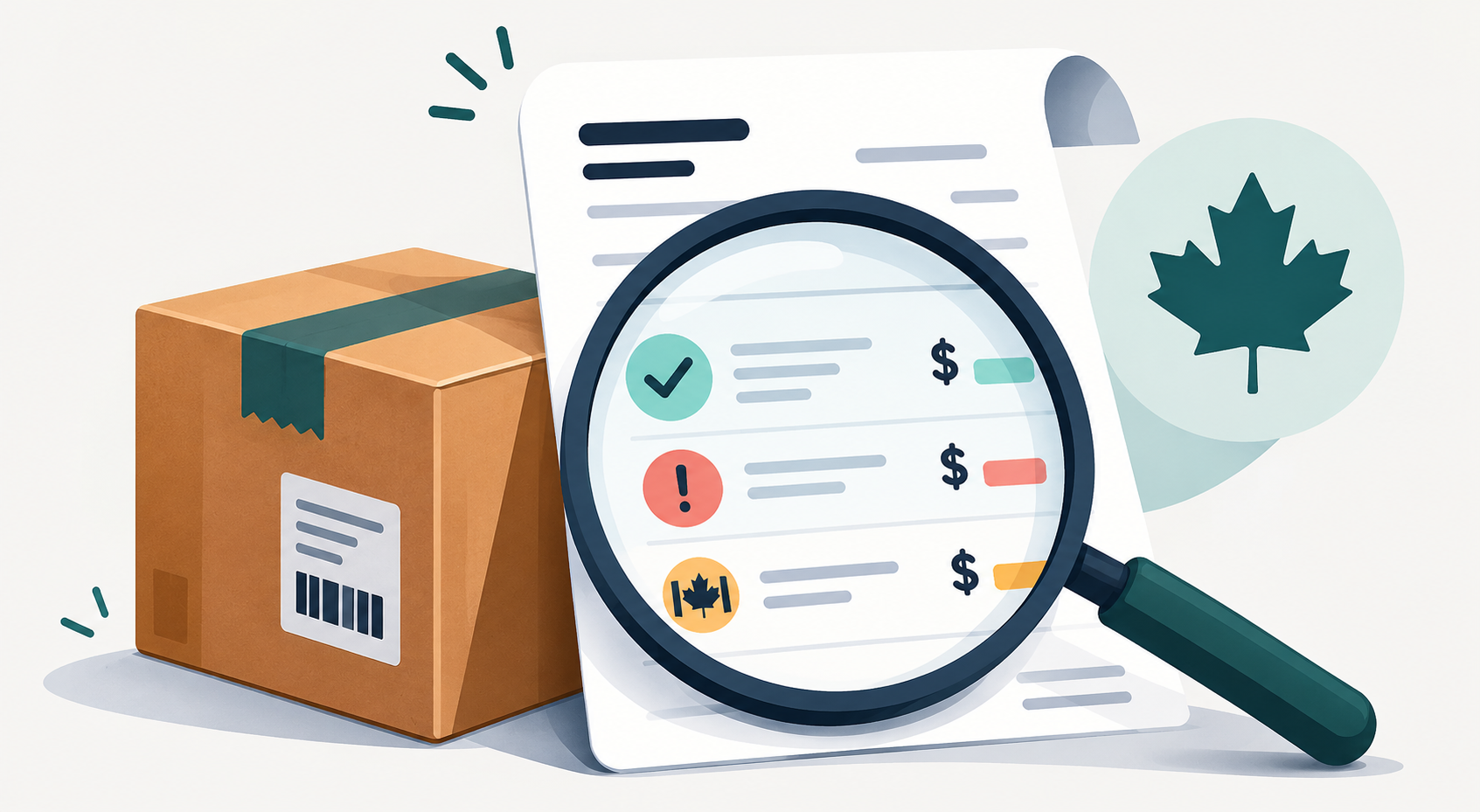
For most Canadian e-commerce merchants, a 10-minute weekly scan of voided labels, cost outliers, and cross-border brokerage catches the vast majority of recoverable errors.
Most Canadian merchants don’t need a massive, 50-point shipping audit. They need a consistent, 10-minute check that catches the three billing errors most likely to drain their margins. If those same errors keep showing up, the invoice isn’t the problem. Your shipping setup is.
At Part n Parcel, we manage shipping economics for 240+ Canadian e-commerce businesses across Canada Post, FedEx, UPS, Purolator, and Canpar. Every merchant gets direct carrier accounts in their name with enterprise rates, which means they can see the rate, see every surcharge, and dispute anything that doesn’t look right, because it’s their account. This guide walks through what to check each week, how to dispute errors with carriers, and when a recurring billing problem is actually a sign of a bigger structural issue.
That’s what most audit guides miss. They teach you to find errors, but never ask why the errors keep happening. The answer, almost every time, is that the merchant doesn’t have visibility into their own shipping economics. They’re shipping on someone else’s account, through an aggregator, or on a rate card they’ve never seen. The invoice is a black box. And you can’t audit what you can’t see.
When we onboard a new merchant, we find recoverable billing issues on nearly every account we review. Voided labels and surcharge outliers are the fastest credits to get back, often resolved in a single phone call. This guide is what we’ve learned about which invoice checks actually matter and which are a waste of time.
What Shipping Invoice Errors Should You Look For?
1. Voided Labels Still Billed
This is the single biggest quick win. You void a label in your platform (Shopify, ShipStation, etc.) because an order was cancelled or reprinted, but the carrier still bills you.
The check: Pull your voided shipments report and cross-reference against your carrier invoice.
The result: If a voided tracking number appears as a charge, that’s money owed back to you. We’ve seen this recovery alone save merchants thousands of dollars annually.
2. Surcharges That Spike Individual Shipments
Every invoice has surcharges: fuel, residential delivery, address correction, oversize, remote area. You don’t need to verify every one. You’re scanning for outliers: any shipment that costs significantly more than your average.
The quick scan: Export your carrier invoice CSV and drop it into an AI chatbot like ChatGPT.
The prompt: “Flag shipments where the total cost is more than 2x my average cost per package and show me the surcharges driving the difference.”
Common culprits: DIM weight recalculations where your box dimensions didn’t match the carrier’s measured dimensions, and address correction fees on mismatched postal codes.
3. Cross-Border Brokerage Errors
If you ship between Canada and the US, brokerage is the biggest billing issue right now. Carriers bill customs brokerage based on declared value, HS code, and CUSMA eligibility.
The risk: Incorrect declared values inflate fees. Wrong HS codes trigger higher duty rates. CUSMA-eligible products that aren’t flagged get charged full brokerage. For a breakdown of recent policy shifts, see what changed for cross-border shipping in 2025.
The fix: If the same brokerage error appears twice, stop disputing the invoice and fix the configuration in your shipping platform.
You can’t dispute what you can’t see. Find out what your setup is hiding →
What Does a Weekly Invoice Audit Look Like?
Nobody follows a 15-step audit matrix past week two. This is the routine that actually survives:
Voided labels (2 min): Pull voided shipments from your platform. Cross-reference against your invoice. Flag anything still billed.
Cost outliers (5 min): Sort your invoice CSV by cost per shipment. Investigate anything 2x above your average. Catch the $35 charge on a package that should have cost $14.
Cross-border brokerage (3 min): Pull your 5 highest brokerage charges. Verify the declared value and CUSMA flags. If the same error repeats, it’s a platform configuration problem, not an invoice problem.
How Long Do You Have to Dispute a Carrier Bill in Canada?
Most major Canadian carriers provide a 90-day window from the invoice date to dispute billing errors, though terms vary by contract. The table below links to each carrier’s published source so you can verify the current window.
| Carrier | Window | How to Dispute | Source |
| Canada Post | 90 days | Call 1-866-607-6301. Investigation fees may apply for invalid disputes. | Canada Post T&C (PDF) |
| FedEx Canada | 90 days | Call 1-800-463-3339 or submit via fedex.ca/invoice. | FedEx Service Guide (PDF) |
| UPS Canada | 90 days | Call billing support (number on invoice) or via UPS Billing Centre. | UPS 2026 T&C (PDF, S.27.4) |
| Purolator | 90 days | Call 1-888-744-7123 or dispute via Purolator Billing Centre. | Purolator Business Rewards T&C |
| Canpar | 90 days | Call customer service or submit via canpar.com. | Canpar Terms of Service (PDF) |
Sourced from each carrier’s published terms of service as of April 2026. Windows may change with annual T&C updates.
How to Get the Credit: Call, Don’t Email
Email disputes are where credits go to die. They’re slow and easily ignored. For fast results:
Call carrier customer service. Don’t call your account rep for routine billing credits, save your rep goodwill for rate negotiations.
Batch your issues. Have 3-5 tracking numbers ready per call.
Use precise language. “Tracking number [X] was voided on [date] but was billed on invoice [Y] for $[amount].”
Ask for goodwill credits. If a charge resulted from a carrier-side issue (late delivery, incorrect scan), agents often have discretion to waive it.
For carrier phone numbers and escalation paths: Canadian Carrier Support Contacts and Escalation Guide.
When the Pattern Means a Structural Problem
A one-off error is an invoice problem. A recurring error is a configuration problem.
- Consistent DIM weight overcharges: your platform is sending the wrong package dimensions to the carrier API. Every shipment gets overbilled until you fix the source.
- Recurring residential surcharges on B2B: your address validation is defaulting commercial addresses to residential.
- Same brokerage errors on cross-border: your HS codes or CUSMA declarations are misconfigured at the SKU level.
- Express rates on ground-speed lanes: your routing rules don’t match your delivery zones. This is the most common silent cost leak we see when onboarding a new merchant.
These leaks are silent and constant. Fixing the source of the data is worth more than a year of manual auditing.
Stop disputing the same error every month. Let’s fix the setup at the source →
Find Out What You’re Losing
If you’re shipping on an aggregator’s account, you often can’t see these surcharges, let alone dispute them. You’re auditing a black box.
A quick look at your current rates and lane mix shows the gap between what you’re paying now and what enterprise carrier accounts in your name would cost on your volume. It takes one short conversation to see what’s being left on the table, and to put the account back in your name so the rate, the surcharges, and the dispute rights are all yours.
Part n Parcel is a managed shipping economics company, not a customs brokerage or legal advisor. This article reflects our understanding of carrier billing processes as of April 17, 2026. Always verify specific terms with your carrier. Get a full shipping cost analysis today from our experts!