
What You Will Learn
- How dim weight is actually calculated, step by step, with real numbers
- The cube factor every major Canadian carrier publishes, in one short table
- Why a box that measures 14.2 inches costs the same as one that measures 15
- Four ways to cut your dim weight bill, ranked by effort
- A free interactive calculator showing your annual cost at list rates
Skip to the calculator if you already know how dim weight works. If you ship parcels in Canada, the number on your invoice is rarely the weight on your scale.
Every carrier compares two numbers for every box. The actual weight, what your scale shows. And the dim weight, the volume of your box converted to weight using a published factor. The bigger number wins. That is what you pay on.
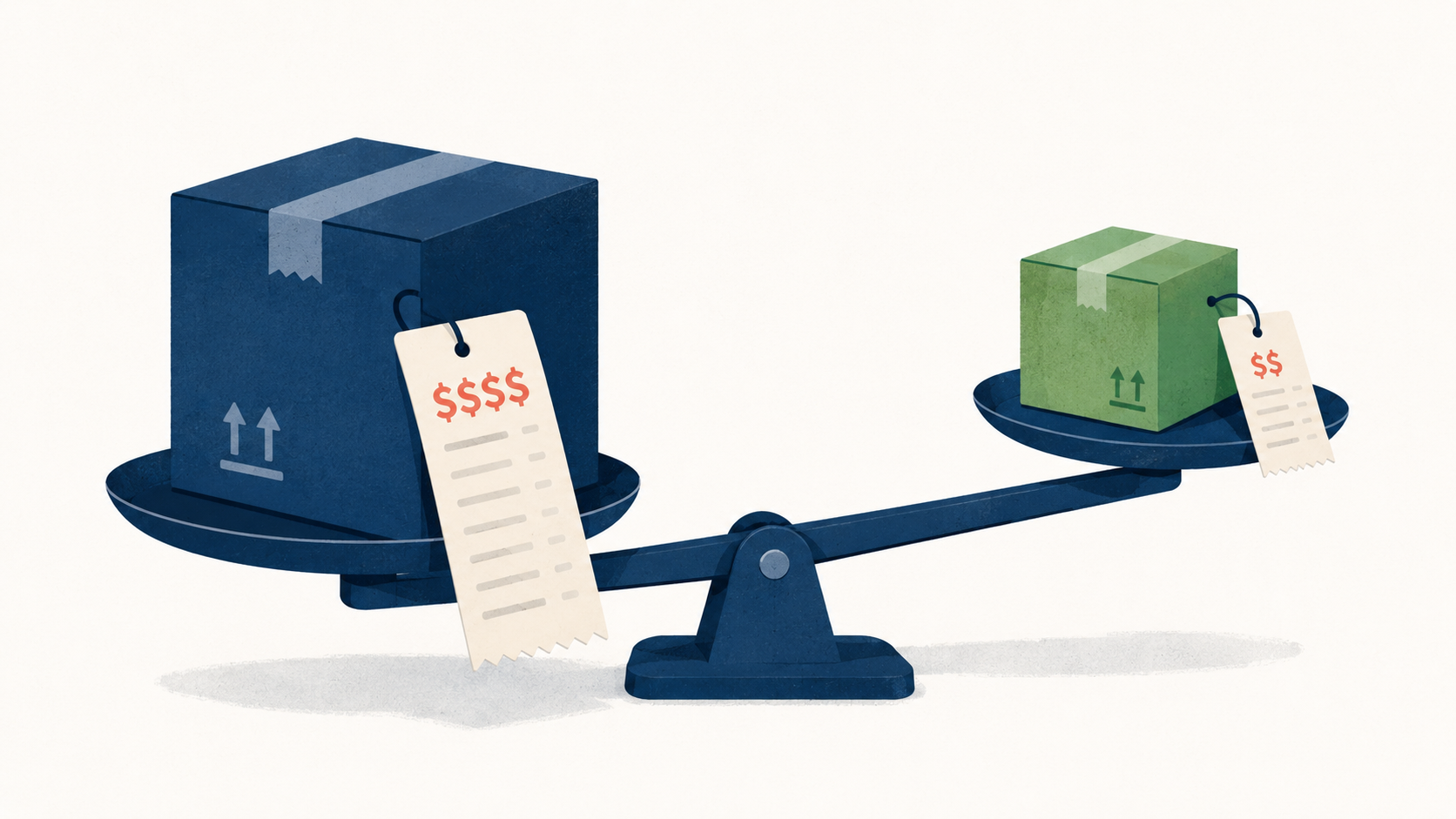
If your box is bigger than the contents need, you are paying for the empty space.
This guide shows you exactly how that math works for every major Canadian carrier, with sources you can verify, and a calculator that does the math on your own boxes.
The Calculator
Use the calculator above to build your current box on the left and a smaller version on the right. The annual savings number on the bottom shows what shrinking the box would cut from your bill at Purolator Ground list rates and your stated monthly volume.
What Is Dim Weight, in Plain English
Dim weight, short for dimensional weight, is how carriers price big but light boxes.
A pillow weighs almost nothing. A pillow in a 14 by 14 by 14 inch box takes up the same truck space as a 30 pound dumbbell. The carrier cannot send the dumbbell instead of the pillow, so the carrier bills the pillow as if it weighed what the dumbbell weighs.
That converted number is the dim weight. It is the volume of your box, divided by a number the carrier publishes, in pounds. Whichever is bigger, your actual weight or your dim weight, becomes your billable weight. The rate card prices that number.
Every major Canadian carrier uses dim weight on at least one service. The math is the same. The divisor and the rounding rules change.
How Carriers Calculate Dim Weight
Six steps.
- Measure the outside of the box. Length, width, and height in inches. Measure the box, not what is inside.
- Round each number to the next whole inch. Some carriers, including UPS Canada and FedEx Canada, publish that each dimension rounds up to the next whole inch before the math runs. (UPS Canada source. FedEx Canada source.) Other carriers may describe the rule differently. The practical point is the same: the dimensions you declare need to match the dimensions the carrier measures, or you pay the gap.
- Multiply the three rounded numbers. That gives you the total volume in cubic inches.
- Divide by the carrier’s cube factor. This number changes by carrier and by service. The table below shows all of them.
- Round the result up to the next whole pound. That is your dim weight.
- Compare to your actual weight. Whichever is bigger is what you pay on.
A Real Example
You ship a 14 by 12 by 10 inch box that weighs 3 pounds on Purolator Ground.
The dimensions are already whole inches, so the volume is 1,680 cubic inches. Purolator Ground’s published cube factor is 12.4 pounds per cubic foot, which is the same as dividing the volume by 139.35 cubic inches per pound. (Purolator Rate Guide, September 2025.)
The dim weight comes out to 12.09 pounds. Rounded up, that is 13 pounds billable. Compare 13 pounds of dim weight to 3 pounds of actual weight. Dim weight wins. You are billed at the 13 pound row of the rate card instead of the 3 pound row.
At Purolator Ground same-province list rates, the gap between those two rows is $4.03 per parcel (Purolator Rate Guide, September 2025, D01 column). If every parcel goes out in this box, that adds up to $24,180 per year at 500 parcels per month.
Run your own box through the dim weight calculator to see the gap on your volume.
Canadian Carrier Cube Factors
There are three bands.
| Cube factor band | Who uses it | What this means for you |
|---|---|---|
| 166 in3/lb (6,000 cm3/kg) | Canada Post Regular Parcel | Most generous. Best for light bulky parcels. |
| 139 in3/lb (5,000 cm3/kg, or 12.4 lb/ft3) | Purolator Ground, Canpar Ground, FedEx Canada, UPS Canada (most services), Canada Post Priority and Xpresspost and Expedited and U.S. and international | Standard. Where most Canadian shipping happens. |
| 115 in3/lb (4,100 cm3/kg, or 15 lb/ft3) | UPS Canada Domestic Air, Purolator Express air services, Canpar Select | Least generous. Big boxes get billed heavily. |
The biggest practical lesson from this table: a single carrier uses different cube factors on different services. Purolator Ground and Purolator Express air are not the same. UPS Domestic Air and UPS Ground are not the same. If you are mixing services, your dim weight math is not constant.
Each carrier’s detailed methodology and source follows.
Purolator
Purolator publishes its cube factor in the rate guide. Ground and non-air Express services use 12.4 pounds per cubic foot. That is the same as 139.35 cubic inches per pound.
Air network Express services use 15 pounds per cubic foot. That is about 115.2 cubic inches per pound, less generous because air capacity is more expensive than ground.
Source: Purolator Rate Guide, September 2025.
UPS Canada
UPS Canada uses two different divisors. Domestic Air packages use 4,100 cm3/kg, equivalent to about 115 cubic inches per pound.
All other packages use 5,000 cm3/kg, equivalent to 139 cubic inches per pound. UPS Canada also publishes that dimensions round up to the next whole number before the math runs.
Source: UPS Canada shipping dimensions and weight.
FedEx Canada
FedEx Canada uses 5,000 cm3/kg, or 139 cubic inches per pound, for both intra-Canada and international packages.
FedEx Canada publishes the rounding rule directly: dimensions round up to the next whole inch or centimetre if the measurement exceeds a whole number.
Source: FedEx Canada dimensional weight.
Canada Post
Canada Post treats dim weight differently across its services. Priority, Xpresspost, Expedited Parcel, U.S., and international services all use 5,000 cm3/kg, or 139 cubic inches per pound.
Regular Parcel uses 6,000 cm3/kg, or 166 cubic inches per pound, more generous. If your products are light and bulky and you can use Regular Parcel for the timing, the cube factor alone can change which carrier is cheapest for your flow.
Source: Canada Post: how to cube an item.
Canpar Express
Canpar publishes its dim weight rules through its rate calculator. Ground service uses 12.4 pounds per cubic foot, the same as Purolator Ground. Canpar Select uses 15 pounds per cubic foot, less generous than Ground.
Source: Canpar rate calculator.
Why Even Small Box Overruns Add Up
The biggest source of unexpected dim weight charges is not the cube factor itself.
It is the difference between the box dimensions you think you are shipping, and the box dimensions the carrier actually measures.
Some carriers, including FedEx Canada and UPS Canada, publish that each dimension rounds up to the next whole inch before the math runs. (FedEx source. UPS source.) Other carriers may describe the rule differently, but the practical point is the same: declared dimensions need to match what the carrier measures.
Walk through the math.
Box A measures 14.0 by 12.0 by 10.0 inches. No rounding needed. Volume is 1,680 cubic inches. Dim weight is 12.09 pounds, rounded up to 13 pounds billable.
Box B is the same physical box, but it actually measures 14.2 by 12.4 by 10.1 inches with tape, tolerance, and a slight bulge. The carrier rounds each dimension up: 15 by 13 by 11 inches. Volume is now 2,145 cubic inches. Dim weight is 15.43 pounds, rounded up to 16 pounds billable.
Same nominal box, but once tape, bulge, and manufacturing tolerance push the outside dimensions over the whole-inch mark, it can become three extra pounds of billable weight. $0.60 per parcel at Purolator Ground same-province rates. $3,600 per year at 500 parcels per month.
The takeaway is not “measure your boxes to the millimetre.” It is that every fraction of an inch over a whole number adds to your bill, with no benefit to anyone. If your standard box is 14.2 inches long, you are paying as if it were 15. Either reduce it to 14.0 or accept that the carrier is treating it as 15.
Want to Know What This Is Costing You Right Now?
The calculator shows the gap at list rates. Your real invoice is different. It reflects your account discount, fuel surcharges, taxes, home address fees, and a dozen other charges most merchants never reconcile.
Send Part n Parcel one recent carrier invoice. We will send back exactly what your bill is, broken into actual weight, dim weight, surcharges, and the parts of your packaging that are avoidable cost.
Free for Canadian e-commerce merchants. No call required. No commitment. One invoice, one PDF back to you.
How to Reduce Your Dim Weight Bill
Four levers, ranked by how easy they are to act on.
1. Switch to a smaller stock box for products that have room to spare
If your product fits in a 12 by 10 by 8 inch box but you ship in 14 by 12 by 10 because that is what you have on hand, you are paying about $24,180 per year extra at 500 parcels per month on Purolator Ground list rates. The smaller box costs pennies more per unit if anything.
Model both boxes side by side in the dim weight calculator before you reorder packaging.
2. Push your box supplier on tolerances
If your boxes consistently measure 14.2 inches when you ordered 14.0, push your supplier to stay under the whole number. Carriers do not round down for manufacturing tolerances. They round up. Every box that ships at 14.1 is billed as 15.
3. Match the carrier and service to your product profile
A merchant whose products skew light and bulky should be on Canada Post Regular Parcel for the flows where the timing works. The 6,000 cm3/kg cube factor is more generous than every other Canadian ground service, by a meaningful margin.
A merchant whose products are dense should be on the 12.4 lb/ft3 band: Purolator Ground, Canpar Ground, UPS Ground, or FedEx Ground.
Air services on UPS Domestic Air, Purolator Express air, and Canpar Select use the least generous cube factor at 115 cubic inches per pound. Avoid these for any box that triggers dim weight unless you need the speed. If your product mix is dim weight heavy, your carrier and service mix matters more than the discount you negotiated on any single service.
A real example. A Toronto-based tea company was shipping heavily on FedEx Express, the air network with the least generous cube factor. Moving the right portion of their volume to FedEx Ground and FleetOptics for local GTA delivery cut their carrier bill by 29 percent. The cube factor on the new service mix was part of that. The rest was the rate. (Part n Parcel case studies.)
4. Audit your last 90 days of invoices
Carriers do not separate dim weight charges from your base rate on the invoice. You have to compute it yourself: actual weight versus billable weight, line by line, across every shipment.
Most merchants have never done this exercise. The merchants who have tend to find that a meaningful percentage of their invoice is avoidable dim weight charges. The bigger the volume, the bigger the find.
Running this audit requires something most merchants on aggregators do not have. A carrier account in their name. A visible rate card. If you are shipping on someone else’s account, you cannot see the dim weight breakdown, the surcharge detail, or the rate structure behind the invoice. You cannot audit what you cannot see.
This is what Part n Parcel does. We set up direct carrier accounts for each merchant, then pull the shipment data, compute the gap, and show you what to change. The account is in your name. The rate card is visible. Every line on the invoice is auditable.
Can You Negotiate Dim Weight?
Short answer: not as a standalone item. Yes as part of the bigger conversation about your overall rate.
The cube factor is set in the carrier’s published rate guide and applies across most retail accounts. There is no separate negotiation on the cube factor itself.
What carriers negotiate is your overall rate. The discount on the base rate, the cap on the fuel surcharge, the accessorial fees, and at higher volume, the treatment of dim weight. These all sit inside one contract conversation. The cube factor is one variable in that conversation, not a separate one.
For most Canadian merchants, the real lever is broader: the overall rate they pay, and the carrier and service mix that handles their volume. A merchant on the wrong service mix pays for dim weight twice, once in the cube factor and once in the rate. A merchant on the right mix often does not need to negotiate dim weight at all, because the cube factor on the chosen service is already favourable.
This is where account structure matters. A merchant negotiating alone, with one carrier, has one rate card and no reference point for what other businesses pay. A merchant shipping through Part n Parcel’s network has enterprise rates across multiple carriers and a managed service layer that matches the right carrier and service to the right shipment. The dim weight math is the same, but the rate it multiplies against is different.
Common Dim Weight Mistakes Canadian Merchants Make
Five patterns, based on the audits Part n Parcel has run across Canadian e-commerce brands.
- Not knowing the box’s outer dimensions. Merchants quote box sizes from memory or from supplier specs. The carrier measures what it scans. If your supplier’s spec says 14 by 12 by 10 but the box ships at 14.25 by 12.1 by 10.3, the carrier bills as 15 by 13 by 11.
- Using oversized boxes for small products. A small product ships in a medium box because that is the box on the floor. Each shipment is a quiet $3 to $5 dim weight charge. Across a year, that becomes a salary line.
- Not noticing when the carrier re-measures. Carriers re-measure parcels periodically. If they find your declared dimensions are smaller than reality, they charge the difference plus a re-measure fee on every future shipment. The line item is buried in the invoice. If you spot one, our Canadian carrier support contacts and escalation guide has the direct numbers to dispute it.
- Assuming all services on one carrier use the same cube factor. They do not. Purolator Ground uses 12.4 lb/ft3 but Purolator Express air uses 15. UPS Domestic Air uses 4,100 cm3/kg but every other UPS Canada service uses 5,000.
- Negotiating rate discounts without thinking about dim weight. Most carrier negotiations focus on “what is the discount on my Purolator Ground rate.” That misses where dim weight lives. The carrier and service mix matters more than the rate on any single service.
Frequently Asked Questions
What is dim weight?
Dim weight is the weight a carrier assigns to your parcel based on the volume of the box. Carriers compare your actual weight to the dim weight and bill you on whichever is bigger. The reason is fairness: a big light box takes up the same truck space as a small heavy one.
Is dim weight the same on every Canadian carrier?
No. Three bands. Canada Post Regular Parcel is the most generous at 166 cubic inches per pound. Most other ground and express services use 139 cubic inches per pound. Air services use about 115 cubic inches per pound, the least generous.
Does Canada Post charge dim weight?
Yes. Priority, Xpresspost, Expedited Parcel, U.S., and international services use 5,000 cm3/kg or 139 cubic inches per pound. Regular Parcel uses 6,000 cm3/kg or 166. Smaller parcels under certain dimensional thresholds may be billed on actual weight only. Check the current Customer Guide for the active threshold.
Why does the carrier round my box up to the next whole inch?
FedEx Canada and UPS Canada publish this rule directly. Every dimension rounds up to the next whole inch before the math runs. The effect for you is that any fraction over a whole number adds to your bill with no benefit to anyone.
Can I negotiate my cube factor?
Not as a standalone item. The cube factor sits inside the bigger conversation about your overall rate. What carriers negotiate is the overall bill: the base rate discount, the fuel cap, the accessorial fees, and at higher volume the treatment of dim weight. For most merchants, the biggest gain comes from the right carrier and service mix, not from chasing the cube factor on its own.
What is a good cube factor?
166 cubic inches per pound is favourable. 139 is standard. 115 is the least generous, used on air services. Lower numbers mean less generous, you pay for more dim weight.
How much does dim weight cost the average Canadian merchant?
Based on shipping audits Part n Parcel has run across Canadian e-commerce brands, dim weight typically represents a meaningful share of the parcel invoice, depending on product mix and carrier. For a brand shipping 50 to 100 parcels a day, the annual dollar impact is significant. Most of it is reducible through better box sizing and a tighter carrier and service mix. We will show you the exact number from your own invoice.
How is dim weight calculated for international shipments?
Same formula, different divisors. UPS Worldwide and FedEx International use 5,000 cm3/kg or 139 cubic inches per pound. Canada Post international services use 5,000 cm3/kg as well. Always verify against the carrier’s international service guide for the destination country.
Ready to Find Your Dim Weight Cost?
The calculator above shows the gap at list rates. To find what you are actually paying, you need to look at your real invoice.
That is what Part n Parcel does. Send us one recent carrier invoice. We send back exactly what your bill is, broken into four categories:
- Actual weight charges, the part that reflects what your packages really weigh
- Dim weight charges, the part you are paying for empty space
- Surcharges and extras, fuel, home address fees, holiday season fees, and the rest
- Avoidable packaging cost, what you could cut with better box sizing
Free for Canadian e-commerce merchants. No call required. No commitment. One invoice, one PDF back to you.