
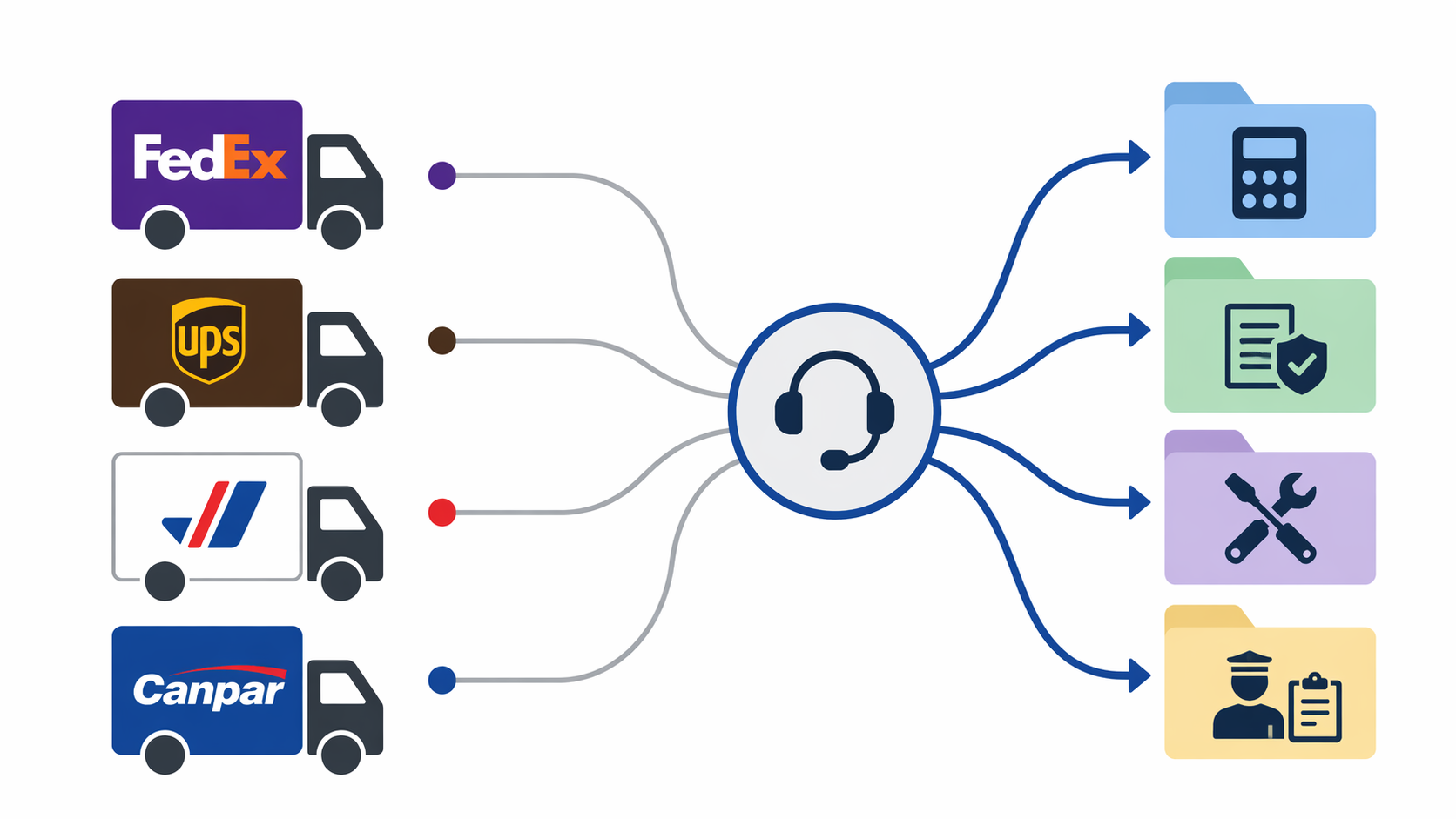
Most carrier support delays don’t come from slow response times. They come from contacting the wrong team. Each of Canada’s major private carriers has specialized internal departments for billing, credits, tech, customs, and claims, and routing your issue to the right one from the first contact is the difference between a two-day resolution and a two-week loop. At Part n Parcel, we manage shipping for 240+ Canadian e-commerce businesses across FedEx, UPS, Purolator, and Canpar every day. This guide shares the contacts and escalation process we actually use.
One note upfront: Canada Post is not covered here. This guide focuses on the four private carriers where Canadian e-commerce merchants see the most optimization opportunity and where we have direct daily operational experience. Also, carrier contact information changes. Verify these contacts on official carrier websites before reaching out.
Why Most Carrier Support Calls Take Too Long
When a shipment trace stalls, a billing credit gets denied, or a customs clearance drags on, the instinct is to call general customer service. The problem is that general customer service isn’t equipped to resolve most of these issues.
Carriers organize their support into specialized teams: billing, credits and adjustments, rebilling, technical support, customs, and claims. Each has its own queue, its own staff, and its own resolution authority. A billing dispute sent to general customer service gets triaged, rerouted, and slowed down because the person who answered the phone can’t act on it. The delay isn’t a capacity issue. It’s a routing issue.
Every hour your team spends in the wrong queue is an hour not spent on your business.
The One-Message Principle
Before getting into specific contacts, there is one practice that cuts resolution time across every carrier: lead with the complete picture in your very first contact.
Most support interactions slow down because the first message establishes the problem, the second provides the account number that was asked for, the third clarifies the shipment date, and so on. Carriers work from case files. The more complete your initial submission, the fewer follow-up rounds you wait through.
Include in your first message:
- Your account number
- The tracking number(s) involved
- The specific dollar amount or service failure in question
- The resolution you’re requesting
- A deadline if one is relevant
One message, one clear ask, one stated resolution. It changes how quickly cases move.
How Carrier Support Is Structured in Canada
Understanding why some contacts work better than others starts with understanding how carriers organize their support.
Canadian carriers maintain tiered account structures. Most e-commerce merchants fall into what carriers classify internally as self-serve or small business tiers: web accounts, standard IVR routing, and limited access to named representatives. Above that threshold sit commercial accounts, preferred customer groups, and enterprise contracts. These tiers don’t just affect pricing. They affect who picks up.
Commercial account holders have direct lines and dedicated email queues that bypass general customer service routing entirely. Some of these channels are documented on carrier websites for account holders. Others are known through direct carrier relationships built over years.
Several of the contacts in this guide are only accessible with a commercial account. They’re included here because understanding what exists is useful even before you have access to all of it. The closing section of this guide explains what account structure has to do with that access.
FedEx Canada Support Contacts
FedEx Canada does not publish email addresses for general support. Most billing and claims interactions happen through their online portals or the direct numbers below. The Revenue Services line gets you to the right team for invoicing and credit issues faster than navigating the main IVR.
| Department | Contact | Notes |
| General customer service | 1-800-463-3339 | Main line (1-800-GoFedEx). IVR routes by account type. |
| Technical support | 1-877-339-2774 | FedEx Ship Manager, API, and systems issues. |
| Revenue services / billing | 1-800-622-1147 | Invoice inquiries and billing disputes. |
| Billing Online platform | 1-833-812-1383 | FedEx Billing Online platform support. |
| Duty and tax rebilling | rebilldt@fedex.com | Cross-border duty and tax rebill requests. Commercial accounts. |
| Claims | fedex.com/en-ca/contact-us/claims.html | Filed online. 15 calendar days from invoice date. |
UPS Canada Support Contacts
UPS Canada’s Preferred Customer Group contacts are documented for institutional and commercial account holders. The 1-877-376-6110 line and preferredca@ups.com are not general customer service. Non-commercial accounts should use the main line.
| Department | Contact | Notes |
| General customer service | 1-800-742-5877 | Main line. Say “Refund” to route directly to claims. |
| Billing | 1-888-592-6188 | Invoice disputes and billing inquiries. |
| Technical support | 1-888-877-8324 | UPS Ready programs, integrations, and tech issues. |
| International docs / customs | internationaldocs.us@ups.com | Cross-border customs document submission. |
| Preferred Customer Group (commercial) | 1-877-376-6110 | Commercial and institutional accounts only. |
| Preferred Customer Group email (commercial) | preferredca@ups.com | Commercial accounts only. Documented in institutional procurement materials. |
Purolator Support Contacts
| Department | Contact | Notes |
| General customer service | 1-888-744-7123 | Branded as 1-888-SHIP-123. |
| Technical support | 1-800-459-5599 | E-ship, developer integrations, and systems. |
| API and web services | webservices@purolator.com | Developer-facing API and web services support. |
| Billing inquiries | billinginquiries@purolator.com | Invoice disputes and billing questions. |
| Billing disputes phone | 1-866-313-4357 | Phone line for billing escalations. |
| Freight | 1-888-302-8819 | Freight-specific inquiries. |
Canpar Support Contacts
Canpar and Loomis Express are both owned by TFI International and share leadership and a building in Brampton, Ontario. They maintain entirely separate support channels. Do not use Loomis Express contacts for Canpar issues.
| Department | Contact | Notes |
| General customer service | 1-800-387-9335 | Main published line. |
| Technical support | 1-866-588-1488 | Systems, integrations, and tech issues. |
| Dedicated customer service (commercial) | dedicatedCS@canpar.com | Found in commercial account materials. Confirm with your account rep before using. |
| Claims | canpar.com/en/support/file_a_claim.htm | Filed via web form. |
The Four-Step Escalation Process
When an issue isn’t resolved through standard support, a documented escalation path works across all four carriers.
Step 1: Call first and get a case number. The phone creates a timestamped case record with a reference number attached. Without a case number, email follow-ups have nothing to attach to. Always get the case number before you hang up.
Step 2: Follow up by email with the case number in the subject line. Email creates a written record and moves the case from a queue to an inbox. Include the case number, a summary of what was discussed on the call, and the specific resolution you’re expecting.
Step 3: Route directly to the specialized team. If general support is stalling, take the case directly to the relevant department using the contacts in the tables above. Reference your existing case number when you reach out.
Step 4: Request a supervisor or a named case manager. If the specialized team isn’t moving the case, ask to escalate to a supervisor. Get the supervisor’s name and direct email so follow-ups go straight to them. Carriers track internal responsiveness metrics. A documented trail of unresolved contacts with timestamps and escalating contacts changes how a case gets prioritized.
This four-step sequence works because it builds a paper trail at every stage. Cases with documented history, specific resolution requests, and multiple department contacts tend to move faster than single calls made in isolation.
Copy-Paste Templates
These are the templates we use for our network. Adjust account numbers, tracking numbers, and dates before sending.
Shipment Trace Request
Subject: Shipment Trace Request – [Tracking Number] – Account [Account Number]
Hello,
I am following up on shipment [tracking number], shipped [date] from [origin] to [destination].
The shipment has not been delivered and tracking has not updated since [last update date and time]. I am requesting a formal trace to determine the current location and expected delivery date.
Account number: [account number] Reference number: [your PO or order reference]
Please confirm receipt and provide an update within 24 hours.
Credit Request
Subject: Credit Request – Invoice [Invoice Number] – Account [Account Number]
Hello,
I am requesting a credit on invoice [invoice number] for [describe the charge, e.g., a residential surcharge applied to a commercial delivery address at 123 Main St, Toronto, ON].
The charge is incorrect because [brief explanation]. Supporting documentation is attached.
Account number: [account number] Tracking number(s): [tracking numbers] Credit amount requested: $[amount]
Please confirm receipt and advise on the timeline for review.
Rebilling / Duty Dispute
Subject: Rebilling and Duty Dispute – [Tracking Number] – Account [Account Number]
Hello,
I am disputing duty and tax charges applied to shipment [tracking number], shipped on [date].
The declared value was $[amount] and the HS code used was [code, if known]. The charges applied were $[amount], which I believe are incorrect based on [brief reason, e.g., the product qualifies under CUSMA or was incorrectly classified].
I am requesting a rebilling review. Supporting documentation is attached.
Account number: [account number]
Please respond with a case number for tracking.
Customs Paperwork Follow-Up
Subject: Customs Clearance Follow-Up – [Tracking Number]
Hello,
Shipment [tracking number] has been held in customs since [date]. The shipment originated in [origin country] with a declared value of $[amount].
All required documentation was submitted at time of shipping: commercial invoice, packing list, and [any additional documents]. If further documentation is required, please specify exactly what is needed so I can provide it immediately.
Account number: [account number] Contact: [your name and direct email]
Please provide a status update and estimated clearance date.
Claiming Refunds for Late Deliveries
Both FedEx and UPS Canada offer service guarantees on select services, and both have a 15-calendar-day filing window from the invoice date. Most merchants miss this window entirely because they don’t know it exists.
FedEx Canada’s money-back guarantee applies to select Express services: First Overnight, Priority Overnight, Standard Overnight, and International Priority variants. FedEx Ground’s guarantee has been suspended since 2020 and was not reinstated as of early 2026. FedEx does not issue refunds proactively. You have to claim them within 15 days of the invoice date. Claims are filed at fedex.com/en-ca/contact-us/claims.html or by calling 1-800-463-3339 and selecting the billing option.
UPS Canada’s guarantee applies to a broader set of services, including Express variants, Expedited, 3 Day Select, and Standard. Claims can be filed through the UPS Billing Center online (View and Pay Bill, then select the tracking number and choose Dispute) or by calling 1-800-742-5877 and saying “Refund.” Approved refunds credit within 3 to 5 business days after an 8 to 15 business day review period.
For both carriers, the process is the same: pull your invoices, identify late deliveries within the past 15 days, and file before the window closes. A single late FedEx Priority Overnight or UPS Express shipment generates a full refund of the shipment cost. At any meaningful volume, the unclaimed refunds add up.
The Contacts You Can’t Access Without a Commercial Account
You may have noticed the commercial-only flags in the UPS and FedEx sections above. The Preferred Customer Group line at UPS (1-877-376-6110). The dedicated accounts pathway at FedEx. These aren’t soft differentiators. They’re different queues with different resolution rates and different rep ratios.
Carriers built tiered support because the economics of managing every account the same way don’t work at scale. A named rep actively managing hundreds of individual small business accounts isn’t viable. So carriers directed SMB accounts toward self-serve tools and IVR routing, while commercial and high-volume accounts retained direct access to people who can act on issues. This is a volume decision, not a service quality decision. It’s just how the math works at scale.
The part that matters for how your shipping is set up today: if your shipping runs through an aggregator or a platform that holds the carrier account, you don’t have a direct commercial account. You’re shipping under their account number. When a billing dispute comes up or a customs clearance stalls, you escalate through their support queue, not your own. The preferred contacts in this guide are not available to you because you don’t have the direct carrier account required to use them.
At Part n Parcel, every member has their own direct carrier account. When a credit needs to be claimed, a rebilling dispute needs to be filed, or a customs clearance is stalling, it’s your case number, your account record, and your escalation path. The contacts in this guide are the ones we use daily across 240+ businesses. Members access those same channels through accounts that belong to them.
If you don’t own the carrier account, you’ve outsourced the carrier relationship. Every time you need help, you wait in someone else’s line.
What Your Current Setup Is Actually Costing You
Every late delivery refund not claimed within 15 days is money that doesn’t come back. Every hour your team spends in a general customer service queue, because you don’t have the commercial contact or the account tier to reach the right team directly, is time that doesn’t come back either.
The gap between a self-serve account and a direct commercial account shows up in every carrier interaction, every invoice cycle, and every support escalation.
If you want to see what your current shipping setup is costing you, the Shipping Savings Estimator is the place to start. Put in your volume and see where the gap sits.
Note: Carrier contact information is subject to change. Verify all contacts on official carrier websites before use. Information in this guide reflects contacts confirmed through official carrier sources as of publication.