If you’re a Canadian e-commerce business shipping to the US, the rules changed in 2025. Not gradually. Overnight.
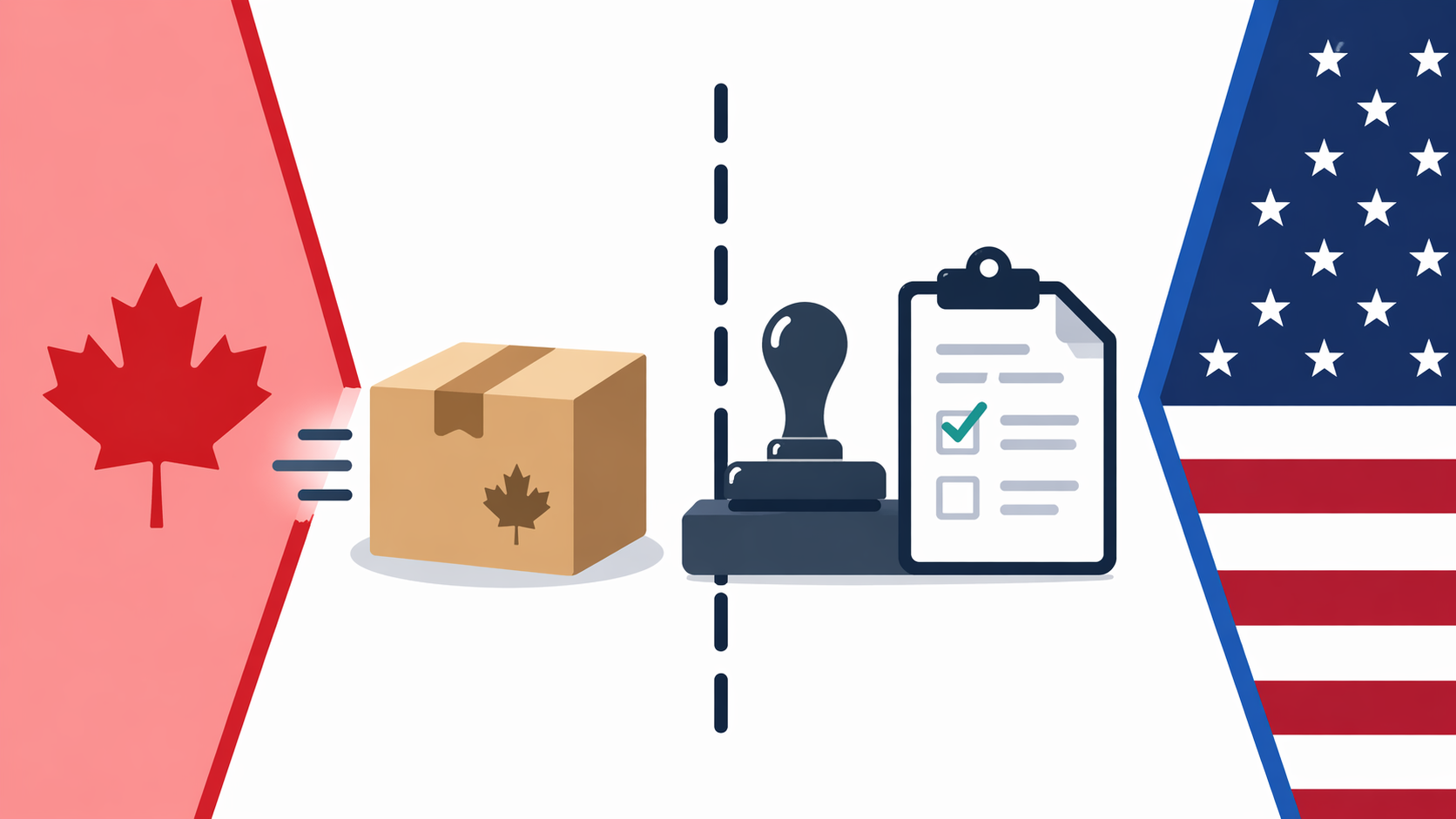
On August 29, 2025, the US eliminated the de minimis exemption, which used to let shipments under $800 USD bypass customs treatment entirely. That exemption covered the vast majority of e-commerce shipments crossing the border. According to US Customs and Border Protection, de minimis packages had grown to over 1.36 billion annually by 2024, accounting for 92% of all cargo entries. Now every package requires an appropriate entry process, whether formal or informal, along with customs documentation and, in most cases, duty and tax payments that didn’t exist before.
For a lot of Canadian businesses, this came as a surprise. Suddenly their US customers were getting hit with unexpected charges at delivery, shipments were getting held at the border, and costs went up across the board. A CFIB survey conducted shortly after the change found 63% of affected small businesses reported higher expenses.
The good news: if you set things up correctly, cross-border shipping is still very doable. You just need to understand what changed.
At Part n Parcel, we work with 240+ Canadian e-commerce businesses on their shipping operations, and cross-border compliance questions have become one of the most common things we help Shopify merchants work through. This guide covers what actually changed, what costs to expect, and the two decisions that matter most.
What Actually Changed
Two big things happened in quick succession.
The de minimis exemption disappeared. Before August 2025, packages valued under $800 USD entered the US with minimal paperwork. Low-value shipments no longer bypass customs treatment and now require an appropriate entry process, whether formal or informal. That means customs clearance costs now matter on every package, whether they are embedded in the rate or billed separately.
Tariffs shifted. In February 2026, the US Supreme Court struck down the broad IEEPA tariffs on Canadian goods. That was welcome news, but it didn’t eliminate tariffs entirely. Non-CUSMA goods now face a 10% tariff under Section 122 of the Trade Act. Section 232 sector tariffs remain in place regardless of CUSMA status and cover a wider range of categories than most merchants realize: steel and aluminum (50%), copper (50%), passenger vehicles and light trucks (25%), medium- and heavy-duty trucks (25%), softwood lumber (10%, with certain wood derivative products at 25%+), and certain advanced computing chips (25%). If your products fall into any of these categories, CUSMA does not help you on those duties. Whether your goods qualify under CUSMA matters more than ever for everything else.
One thing worth knowing: the Section 122 tariff has a 150-day statutory limit, which means it’s currently set to expire July 24, 2026. Section 122 is also facing its own legal challenge at the Court of International Trade. The risk isn’t that the tariff disappears overnight, but that the legal foundation shifts again before July 24, prompting another policy pivot. The administration has signaled Section 301 as a likely replacement authority once Section 122 expires, but the specific scope and timing remain uncertain. For CUSMA-qualifying goods, none of this matters. They’ve remained exempt through every tariff authority so far. We update this section as the situation develops.
IEEPA Refunds: Real Money Back for Some Merchants
If your business shipped goods to the US while IEEPA tariffs were in force on Canadian goods, you may have paid duties that the Supreme Court subsequently ruled unlawful. Potential refunds depend on which IEEPA-specific duties were paid during the period those measures remained in force. Only the IEEPA-specific portion is refundable. Other duties such as most-favoured-nation rates, the Merchandise Processing Fee, and Section 232 tariffs remain due and are not part of the refund.
CBP is moving refunds to ACH and electronic refund workflows through ACE, so importers should confirm ACH refund setup and US bank details with their broker. One important nuance for Canadian businesses: to receive the refund directly via ACH, your bank account must be NACHA compliant, meaning it needs a US routing number. Most major Canadian banks have accounts that meet this requirement, but it’s worth confirming with your bank before setting up. If your bank doesn’t qualify, you can designate your customs broker as the notify party instead.
CBP is building out a new system called CAPE (Consolidated Administration and Processing of Entries) to manage these refund submissions. CBP is still operationalizing the refund process, so check directly with your carrier’s brokerage team or a licensed customs broker for your specific entries.
The Three Costs You Need to Understand
Every cross-border shipment to the US now carries up to three layers of cost on top of your shipping rate.
Customs duties are a tax that US Customs charges based on product classification and country of origin. Every product has a classification code that determines the duty rate. Canadian-made goods can qualify for 0% duty under the CUSMA trade agreement, but only if the right paperwork is on file. Without it, full duty rates apply automatically.
Customs fees are government import processing costs such as the Merchandise Processing Fee (MPF). One important note: MPF is exempt on successful CUSMA claims, which is another reason to get your CUSMA paperwork in order.
Carrier clearance fees are brokerage and disbursement fees charged by your carrier to clear your goods through US customs. UPS Express and FedEx Express include brokerage in the shipping rate at no additional charge. UPS Standard (ground) charges brokerage separately per shipment, with the fee varying based on declared value. Disbursement fees may also apply when the carrier advances duty or tax payments on your behalf. Check current rates directly with your carrier, as these figures change.
CUSMA Is the Single Most Important Thing to Get Right
CUSMA (the Canada-United States-Mexico Agreement, sometimes called USMCA) lets Canadian-made goods enter the US at 0% duty. But it only works if the importer makes a valid CUSMA claim and has the required certification data on hand, whether on an invoice, a separate document, or transmitted electronically. Most merchants find it easiest to work through their carrier’s brokerage team to set this up. Without a valid claim, US Customs charges full duty rates on every shipment, even if your goods actually qualify for zero. This is the single biggest mistake we see businesses make.
Getting set up is straightforward. Download a fillable CUSMA form from your carrier (both UPS and FedEx have their own versions), contact their brokerage team to help you complete it, and submit it. Ask about a blanket certificate, which covers all shipments of the same goods for up to 12 months so you don’t have to file one per shipment.
One important limitation: CUSMA exemptions cannot be claimed for goods shipped through the postal stream (Canada Post to USPS). This is a structural issue with how postal customs clearance works. If cross-border shipping to the US is a meaningful part of your business, commercial couriers are the right choice.
One thing merchants often ask about: will CUSMA still be around? The short answer is yes, for now. There is a July 1, 2026 review deadline, but that review is about whether to extend the agreement for another 10 years, not about dismantling the current benefits. CUSMA has been preserved through every tariff escalation to date, and CUSMA-compliant goods have remained the only truly tariff-free lane into the US under every authority that has been applied. That could change, but it hasn’t yet.
If you’ve been shipping CUSMA-eligible goods without the right certification in place, there’s also a retroactive window worth knowing about. Merchants can typically claim CUSMA treatment retroactively for shipments made within one year after importation, as long as the goods qualified at the time. If you’ve been paying full duty rates on goods that should have been exempt, it’s worth asking your carrier’s brokerage team whether a retroactive claim is possible for recent shipments.
Who Pays the Duties: DDP vs DDU
This is the other big decision. DDP (Delivered Duty Paid) means you pay all duties and taxes upfront. Your US customer sees no extra charges at delivery. DDU (Delivered Duty Unpaid) means your customer gets a bill at the door for duties and taxes before the carrier releases the package.
We recommend DDP for most e-commerce businesses. The customer experience is cleaner, and it avoids a real financial risk. Both UPS and FedEx contractually state that when a consignee refuses to pay DDU charges, those charges get billed back to the original shipper. We’ve seen members get hit with thousands in unexpected rebilling because of this.
The catch is that DDP means accounting for duty and brokerage costs in your US pricing. But that’s a math problem, not a shipping problem, and it’s much easier to solve proactively than to deal with angry customers and rebilled charges after the fact.
One tool worth looking into if you’re running DDP: UPS launched a Shopify and WooCommerce plugin in March 2025 called Global Checkout that calculates duties, taxes, and fees in real time at checkout, so your US customers see the full landed cost before placing the order. We haven’t reviewed it ourselves yet, but it’s a direct response to the post-de minimis environment and worth exploring. Contact your UPS account executive or email globalcheckout@ups.com for details.
What to Do Next
We built an interactive cross-border shipping guide that walks you through everything based on your specific situation: what you’re shipping, which carrier you use, and whether your products need FDA clearance. It takes about five minutes and gives you a personalized checklist with the exact contacts, links, and steps for your setup.
If you’d rather skip the walkthrough and just need contacts and resources, the guide also has a quick reference page with UPS and FedEx brokerage contacts, rate card links, and what to do if something goes wrong.
Questions about your specific setup? Email us at hello@partnparcel.com.
Frequently Asked Questions
Do I need a customs bond to ship to the US?
For many routine courier shipments under the informal entry threshold, the carrier’s brokerage process handles clearance. Formal entries often require a CBP bond. Commercial textile shipments can require formal entry regardless of value. Ask your carrier’s brokerage team about your specific products.
What is a CUSMA certificate and do I need one?
A CUSMA certification proves your goods are made in Canada (or the US or Mexico) and qualify for 0% duty under the trade agreement. There is no single prescribed form. The required data elements can appear on an invoice, a separate document, or be transmitted electronically. If your products are Canadian-made, yes, you need a valid CUSMA claim on file. Without it, you’ll pay full duty rates on every shipment.
What’s the difference between DDP and DDU?
DDP (Delivered Duty Paid) means you pay all duties and taxes. Your customer sees no extra charges at delivery. DDU (Delivered Duty Unpaid) means your customer pays at delivery. We recommend DDP for e-commerce: DDU creates a poor customer experience, and if your customer refuses the charges, the carrier bills them back to you.
Do my products need FDA clearance?
Food, beverages, dietary supplements, and animal feed are regulated by the FDA and require Prior Notice before entering the US. Cosmetics are not subject to FDA Prior Notice. They fall under a separate US regulation called MoCRA (Modernization of Cosmetics Regulation Act), which requires facility registration and product listing, not Prior Notice. General goods like clothing, electronics, and home products typically do not have special FDA requirements, though commodity-specific exceptions exist. Check with your carrier’s brokerage team if you’re unsure.
Is brokerage included in my shipping rate?
For UPS Express and FedEx Express, yes. Brokerage is included in the shipping rate with no separate charge. For UPS Ground, brokerage is charged separately per shipment, with fees varying based on declared value. Check current rates directly with your carrier as these figures are updated periodically. The fees cover entry preparation, disbursement, and the processing required to clear your goods through US Customs.
Where to Start
CUSMA paperwork, carrier selection, and DDP pricing are the three things that make or break cross-border shipping for most Canadian e-commerce businesses right now. Every shipment you process without the right setup is a shipment where margin leaks or a customer gets an unexpected bill. Use the cross-border shipping guide to see exactly where your current setup stands.
Part n Parcel is a managed shipping economics company, not a customs brokerage, licensed customs broker, or legal advisor. This article reflects our current understanding of carrier processes and customs requirements as of 16th of April, 2026. Regulations, tariffs, and carrier practices change without notice. For anything specific to your products, HS codes, or customs classifications, work directly with your carrier’s brokerage team or a licensed customs broker. build a shipping policy