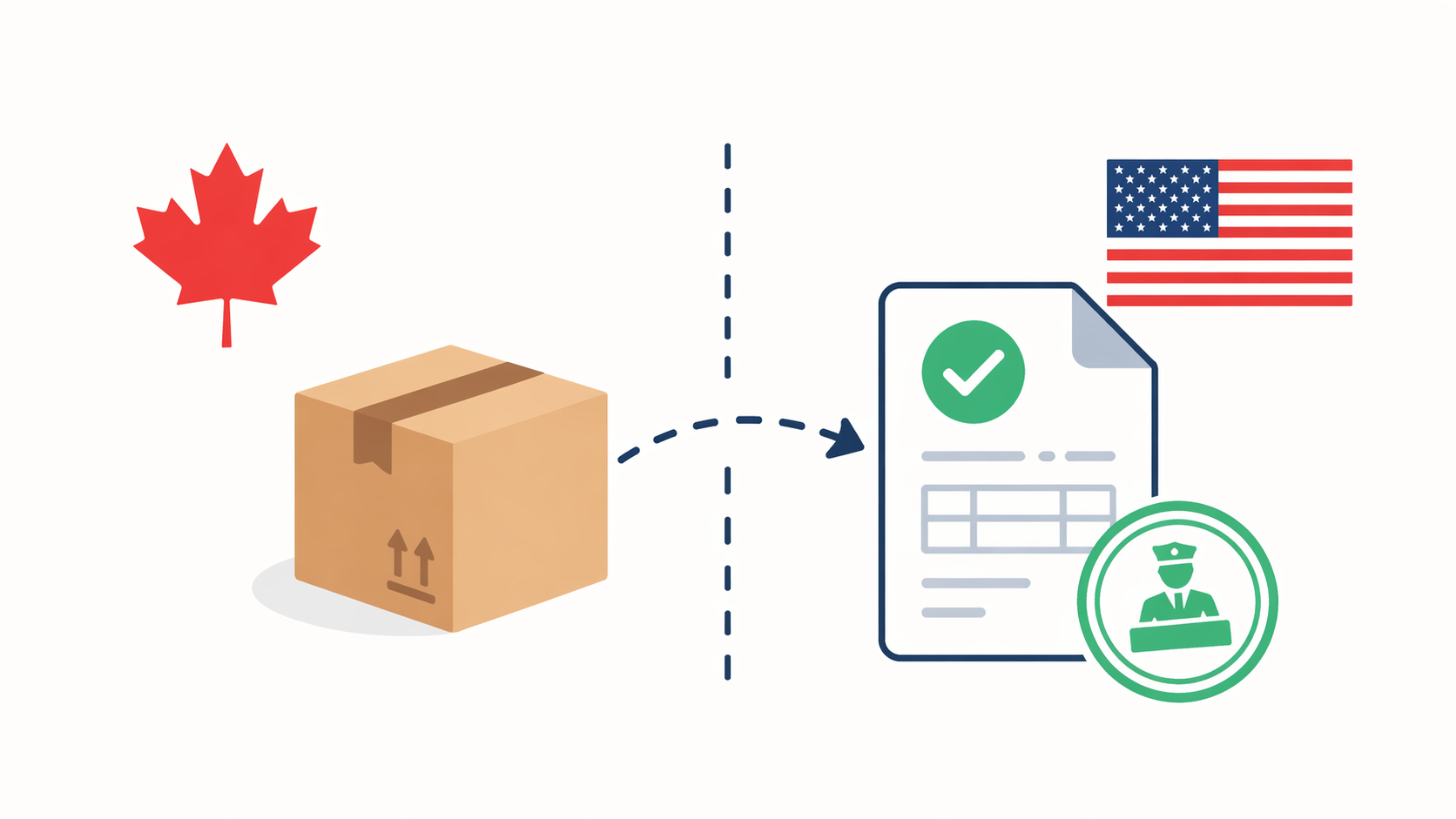
As of August 29, 2025, the U.S. suspended duty-free de minimis treatment for low-value imports from all countries, including Canada. Low-value shipments no longer bypass customs treatment just because they are under US$800. Non-postal shipments now require an appropriate customs entry, and if you want CUSMA/USMCA preference, the importer must make the claim using an appropriate formal or informal entry.If your customs setup isn’t right, you’re paying duties you don’t owe. And if you’re using a shipping aggregator that handles clearance on your behalf, you may not even know it’s happening.
The good news: most Canadian goods qualify for zero-duty treatment under the Canada-United States-Mexico Agreement (CUSMA). The problem is that qualification alone doesn’t protect you. Your product data needs to transmit correctly to customs, and for most businesses, that’s where things break down.
This guide covers everything you need: what’s changed, how CUSMA works, what your customs data needs to include, which carriers handle cross-border shipments correctly, and how to set up DDP so your customers never see a surprise charge at the door.
What Changed: No More De Minimis
Before August 29, 2025, many shipments valued at or below US$800 could enter the U.S. under de minimis treatment with far less customs friction. Canadian businesses shipping lower-value direct-to-consumer parcels often avoided the full customs process.
That exemption is gone. Non-postal shipments now require an appropriate customs entry, along with the shipment data needed to support clearance and any preferential claim you want to make. That usually includes a commercial invoice, product classification, country of origin, and, where applicable, valid CUSMA/USMCA certification data.
This doesn’t mean every shipment will owe duties. It means every shipment now has to prove it doesn’t. The documentation requirements that previously applied only to higher-value goods now apply across the board. If your data isn’t set up correctly, customs defaults to the standard tariff rate.
For Canadian businesses without direct carrier accounts, this creates a real problem: you’re dependent on aggregators to transmit your customs data correctly, and you have limited visibility into whether they’re doing it.
For a full breakdown of the 2025 tariff changes, what they mean for Canadian merchants, and how the current landscape is evolving, see Cross-border shipping from Canada to the US: What changed in 2025 and what to do about it. The rest of this guide covers how to set everything up correctly.
Why Do Canadian Businesses Pay Duties on CUSMA-Qualified Goods?
Qualification isn’t the issue. Most Canadian goods qualify for zero-duty treatment. The issue is data transmission.
Your e-commerce platform has one product description. Your invoice has another. Your carrier transmits a third to customs. The inconsistency flags the shipment for manual review or triggers a default duty rate.
Four data problems account for most unnecessary duty charges:
Product descriptions don’t match across systems. Your Shopify listing says “Cotton T-Shirt.” Your commercial invoice says “Apparel.” Your label says “Clothing.” To customs, these look like three different products.
CUSMA certification exists but doesn’t transmit. You completed the paperwork. Your shipping platform never includes it in carrier data. From customs’ perspective, no certification exists.
HS codes are incomplete. Canada uses 8-digit codes. The US requires 10-digit codes. Incomplete codes trigger manual review instead of automated clearance.
Country of origin is missing. CUSMA only applies to goods originating in Canada, the US, or Mexico. Without a clear origin declaration, customs can’t apply preferential treatment.
According to Statistics Canada, the US was the destination for 75.9% of Canada’s total merchandise exports in 2024. Getting the customs layer right matters at every scale.
What Is CUSMA and How Does It Eliminate Duties?
CUSMA replaced NAFTA in July 2020. For qualifying goods shipped between Canada, the United States, and Mexico, it sets the duty rate to zero.
Three requirements determine qualification:
Your product must originate in Canada, the US, or Mexico. Origin has specific definitions:
- Raw materials were extracted in CUSMA territory
- The product contains only materials from CUSMA countries
- The product meets specific rules allowing certain percentages of non-CUSMA materials
You must have valid certification. Your certification must include:
- Your company information
- Product description and HS classification
- A statement that goods qualify as originating
- Date and signature
The importer must have valid CUSMA certification data in its possession when making the preferential claim. In practice, many businesses route that information electronically through their broker, carrier, or shipping platform, but there is no prescribed format and the certification can appear on an invoice or another document. Certification sitting in your files without being used for the claim does nothing.
The CBSA’s guide to certifying origin under CUSMA outlines the minimum data elements required and confirms certification can be placed on a commercial invoice or any other accompanying document.
What About Non-CUSMA Goods?
For goods that don’t qualify under CUSMA, tariff rates are significant and continue to shift with US trade policy. Rather than cite specific rates here, which can go stale quickly, see our full breakdown in Cross-border shipping from Canada to the US: What changed in 2025 and what to do about it.
It’s also worth noting that certain product categories, including steel, aluminum, automotive goods, and others, are subject to Section 232 tariffs that apply regardless of CUSMA status. These are separate from general tariffs and don’t receive the CUSMA zero-duty treatment. If your products fall into one of these categories, get specific guidance before assuming zero-duty treatment applies.
What Data Does Customs Actually Need?
Customs clearance happens electronically before goods arrive. Three data layers determine whether shipments clear with zero duties.
Product Identity
Complete descriptions are required. “Shirt” won’t cut it. “Men’s cotton t-shirt, crew neck, short sleeve” provides the specificity customs systems need.
Full 10-digit HS codes matter. Your shipment data ultimately needs a U.S. 10-digit HTS classification. If your internal systems stop at shorter Canadian tariff coding, you need a process to map those products accurately before entry. The Harmonized System is maintained by the World Customs Organization and classifies every traded product globally.
Material composition affects classification. Cotton percentages, synthetic blends, metal content: these determine classification and duty treatment for non-CUSMA goods.
Country of origin must be declared per product. “Made in Canada” is not assumed. State it explicitly for every item.
Trade Eligibility
Many businesses complete CUSMA certification paperwork and never configure their shipping platform to include it. The carrier sends product data without any CUSMA claim. Customs applies standard duty rates.
Your shipping platform integration should automatically include:
- Certification statement
- Certifier information
- Product-specific origin claims
This transmission happens through carrier APIs. Manual intervention per shipment doesn’t scale beyond minimal volume.
Clearance Type
Two entry types exist: informal and formal.
With the de minimis exemption gone, all shipments now require either informal or formal entry depending on value and product type. Formal entry applies to higher-value shipments and regulated products, and incurs additional fees regardless of CUSMA status.
Certain products can trigger formal entry or additional agency requirements regardless of low value:
- Commercial textile shipments
- Food, beverages, dietary supplements, and animal feed that require FDA Prior Notice
- Products subject to partner government agency review
With de minimis gone, FDA data requirements now apply to a much wider range of goods than most businesses expect. The specific data fields required depend on your HTS code. If your products fall into a regulated category and your platform isn’t configured to capture and transmit those fields, your shipments will be held at the border regardless of CUSMA status.
Are You Paying Duties or Fees? (And What’s the Difference?)
Confusion between these two categories causes significant frustration and wastes time troubleshooting setups that are actually working correctly.
| Cost Type | Purpose | When It Applies |
| Customs Duties | Tax on imported goods | When CUSMA doesn’t apply or data is incorrect |
| Merchandise Processing Fee | Government administrative cost | May apply depending on entry type; exempt on qualifying USMCA-originating goods when preference is properly claimed |
| Brokerage Fee | Carrier’s clearance service | All shipments |
| Disbursement Fee | Carrier payment on your behalf | When duties or taxes are owed |
| Bond Fee | Guarantees duties will be paid | Formal entries |
CUSMA can eliminate customs duties on qualifying goods. It does not automatically eliminate every other cross-border cost. Carrier brokerage, disbursement, and other service fees can still apply, and whether government processing fees apply depends on the entry and the claim.
A properly documented CUSMA shipment can still carry non-duty costs. Businesses expecting zero total landed cost get surprised, then spend time troubleshooting a setup that may actually be working correctly.
How Do You Set Up CUSMA Certification?
Step 1: Determine Product Qualification
Review CUSMA’s rules of origin for your specific products. The agreement includes general rules and product-specific rules.
Examples:
- Many textile and apparel products are subject to product-specific “yarn-forward” style origin rules. Check the rule that applies to your exact HTS classification before claiming CUSMA.
- Electronics have regional value content requirements
- Food products follow wholly obtained or specific processing requirements
CBSA’s memorandum on CUSMA rules of origin provides a full breakdown of the product-specific rules and links to the CUSMA Rules of Origin Regulations.
Step 2: Create Certification
CUSMA allows flexible certification format. A statement on your commercial invoice is sufficient:
“I certify that the goods described in this document qualify as originating and the information contained in this document is true and accurate. I assume responsibility for proving such representations and agree to maintain and present upon request documentation necessary to support this certification.”
Include your company name and address, product description and HS codes, date, and signature.
Step 3: Configure Your Shipping Platform
This is where most businesses lose the CUSMA benefit. Configuration appears in carrier account settings under customs information. You need to:
- Enable CUSMA/USMCA claims
- Enter or upload certification text
- Map certification to specific products
- Run test shipments to verify certification transmits correctly
FedEx, UPS, and Purolator all support electronic CUSMA transmission. Required fields vary by carrier. Proper platform configuration ensures certification data flows correctly across all carriers in your network. The test-and-troubleshoot cycle on your own can take weeks, and working with someone who has configured this across hundreds of businesses saves real time.
Step 4: Maintain Records
Maintain supporting documentation for the applicable recordkeeping period: generally five years from entry for U.S. customs records and six years from the import date for Canadian records:
- Purchase orders showing material origins
- Manufacturing records
- Cost breakdowns demonstrating regional value content
You don’t send these with shipments. You produce them if customs requests verification.
One thing many businesses miss: CUSMA qualification is not permanent. If you change a supplier, shift where goods are processed, or alter the material content of a product, your existing certification may no longer be valid. Any of those changes requires you to re-evaluate and re-certify before continuing to claim preferential treatment. Building a supplier change review into your operations process prevents a situation where you’re claiming CUSMA on goods that no longer qualify.
Should You Use DDU or DDP for US Shipments?
| Factor | DDU | DDP |
| Who pays duties/fees | Customer | Merchant |
| Customer experience | Surprise charges at delivery | No surprises |
| Merchant visibility into costs | Limited | Complete |
| Cart abandonment risk | Higher | Lower |
| CUSMA benefit applied consistently | No | Yes |
DDU means customers pay customs costs at delivery. With de minimis gone, customers now see fees on every US-bound shipment. Some refuse delivery. You eat the return shipping. Reviews mention hidden charges.
DDP means you pay customs costs upfront and build them into your pricing. For CUSMA-qualified goods, this becomes a predictable per-shipment cost. You control the math. Customers check out without surprises.
Most Canadian businesses shipping to the US are better off with DDP. The operational advantages: cost control, no customer surprises, consistent checkout experience. These outweigh the administrative work. With CUSMA properly configured, your per-shipment cost is predictable enough to price around.
The trade-off: you need accurate estimates built into your pricing. Test your duty calculators against actual invoices to verify accuracy before scaling.
Which Carriers Handle Cross-Border Shipments Best?
The postal stream is not suitable for CUSMA-qualified shipments. USMCA preference cannot be claimed on postal shipments subject to Executive Order 14324, regardless of origin. If you’re shipping through Canada Post expecting CUSMA to eliminate duties, that exemption won’t apply. Canada Post does offer prepaid duties via their Zonos partnership, but that’s duty prepayment, not CUSMA qualification. For CUSMA preference, use a commercial carrier (UPS, FedEx).
For US-bound e-commerce shipments, UPS and FedEx are the primary options. Here’s what to evaluate:
Integrated brokerage. Both carriers handle customs clearance in-house for most shipments. You don’t need a separate broker for standard e-commerce parcels. Brokerage is part of the carrier relationship.
DDP capability. Both UPS and FedEx support DDP billing. This requires proper account configuration. It’s not active by default.
CUSMA processing. Both carriers accept electronic CUSMA certifications through their APIs and apply preferential duty treatment to qualifying shipments. This only works if your shipping platform is configured to transmit certification data correctly.
Tracking visibility. Both provide event-level tracking that includes customs clearance milestones. For cross-border shipments, this means you and your customers can see exactly where a parcel is in the clearance process.
A multi-carrier approach consistently outperforms single-carrier setups. Different carriers perform differently by shipment weight, origin city, and destination. Access to multiple direct carrier accounts means your platform can automatically route each shipment to the best option, based on real rates rather than aggregator-marked-up pricing.
Through working with 240+ Canadian member companies, we’ve consistently found multi-carrier strategies reduce shipping costs by 15–40% while improving delivery reliability.
What Mistakes Cause Unnecessary Customs Costs?
Generic product descriptions. “Apparel” or “Parts” will not clear automatically. Customs needs specificity. Create complete descriptions in your product database and keep them consistent across all systems.
Incomplete HS codes. Six-digit codes can slow clearance because US entries require a 10-digit HTS classification instead of automated clearance. This adds processing time and fees. The Canadian Customs Tariff provides complete classification guidance.
Missing country of origin. Even if 100% of your inventory is Canadian, you must declare it explicitly per product. Don’t assume it’s implied.
Inconsistent data across systems. Your platform, your invoice, and your label all need to say the same thing. Inconsistency reads as multiple different products to customs systems.
Ignoring material composition. Textiles require fiber content percentages. Electronics need material breakdowns. Food products need ingredient lists.
Not testing certification transmission. One successful test doesn’t guarantee ongoing accuracy. Verify certification appears in customs data regularly, particularly after platform updates or carrier account changes.
How Do You Prevent Data Errors at Scale?
Manual customs documentation breaks at volume. At 50 orders a month, you can manage it manually. At 200, you can’t.
Shipping Platform Integration
Your e-commerce platform should feed directly into your shipping platform. This eliminates manual entry and reduces inconsistency.
Order data should flow from your store to your shipping system automatically, with customs data included: product descriptions, HS codes, origin declarations, and CUSMA certifications in every carrier transmission.
Critical configuration:
- Product descriptions map correctly across systems
- HS codes attach to SKUs automatically
- Country of origin includes with every product
- CUSMA certification applies to qualifying shipments
- Material composition appears where required
Automated Duty Calculation
Most shipping platforms include duty calculators. For DDP shipping, you need reliable estimates to price correctly. Test calculators against actual invoices regularly to verify accuracy.
Carrier API Integration
Direct API connections between your platform and carriers enable real-time rate shopping, automatic carrier selection, and label generation with customs data embedded.
The distinction between aggregator accounts and direct carrier accounts matters here. With aggregator accounts, your customs data passes through a consolidated billing layer, giving you limited visibility into how it’s being handled. With direct accounts, you transmit directly to the carrier API and can verify exactly what’s being sent.
Ready to Clean Up Your US Shipping Setup?
Getting cross-border right is a one-time setup with ongoing data maintenance.
Initial setup:
- Determine CUSMA qualification for all products
- Create certification documentation
- Configure your shipping platform with complete product data
- Run test shipments and verify customs clearance
- Establish direct carrier accounts with API integration
Ongoing maintenance:
- Audit product data quarterly
- Update HS codes when products change
- Re-evaluate CUSMA certification whenever you change a supplier or alter how goods are processed
- Monitor clearance times and fee patterns
- Maintain CUSMA documentation for the required period (five years US, six years plus year of entry Canada)
- Review carrier performance
If your current setup runs through a shipping aggregator, you may not have visibility into whether any of this is configured correctly. The gap between what you’re paying and what you should be paying is probably bigger than you think.
See Part n Parcel’s cross-border shipping guide for a deeper look at how we set this up for Canadian merchants, and contact us to see what your current setup is actually costing you.
Last updated: April 2026. Tariff rates and trade policy change frequently. Contact Part n Parcel for current guidance.