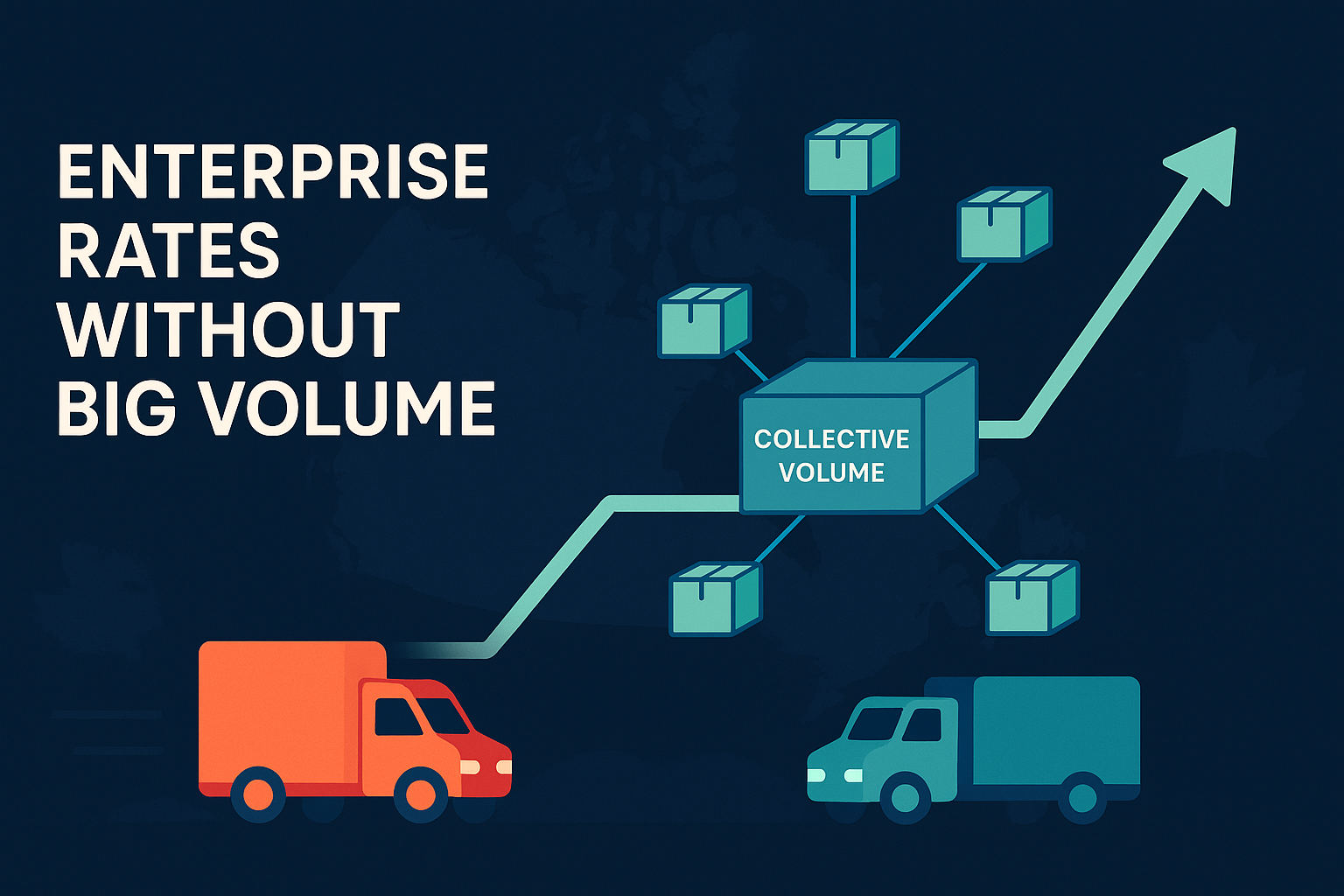
Getting competitive freight rates without large shipping volumes requires different tactics than traditional negotiation. The most effective approach is joining a closed network or buying group that pools volume from multiple businesses, giving you access to enterprise rates through collective buying power. Beyond this, carriers respond to committed volume and operational consistency. Factors like payment reliability, and growth potential are arguments that are just nice to have add ons.
Why Traditional Rate Negotiation Fails for Small Businesses
When you contact a carrier directly, you typically hear “we need to see consistent monthly volume” before they’ll discuss enterprise rates. This creates a frustrating catch-22: you need better rates to grow profitably, but carriers want to see that growth before offering better rates.
The reality is that carriers structure their pricing based on volume tiers and service commitments. Published rates exist for businesses shipping sporadically. Contract rates require demonstrating sustained volume or guaranteed minimums. Enterprise rates remain reserved for high-volume shippers who can commit to baseline volumes across multiple service levels.
This pricing structure makes sense from the carrier’s perspective. They need predictable volume to plan routes, allocate resources, and justify discounted pricing. A business shipping 50 packages weekly presents more uncertainty than one shipping 500 packages daily. UPS even uses a tiered pricing structure based on a 52 week rolling average. That means pricing can vary week to week. It takes 52 weeks to ramp up, all so UPS is protected. FedEx has been known to add fines if volume commitments are not hit. Purolator provides a very short window to hit the volume requirement before adjusting rates.
But this doesn’t mean small and medium businesses are stuck with published rates forever.
Alternative Strategies to Access Better Shipping Rates
Strategy 1: Join a Closed Network or Buying Group
The fastest path to enterprise rates without personal volume commitments is accessing collective buying power. Buying groups pool shipping volume from multiple businesses to negotiate rates typically reserved for much larger companies.
We’ve worked with over 240 Canadian businesses through this model. Each member maintains their own direct carrier account and gets full visibility into their costs, but they benefit from enterprise rates negotiated based on the group’s collective volume. A Toronto-based apparel company joined our network while shipping just $20,000 annually and immediately accessed rates they couldn’t have negotiated alone for years.
The key advantage: you get better rates on day one without waiting to scale your business. Shipping costs directly influence customer behavior, with 67% of consumers less likely to shop with brands charging high shipping fees. Lower shipping costs mean you can offer competitive rates to customers while protecting margins.
When evaluating buying groups, look for these characteristics:
- Direct carrier accounts in your name (not shipping through a third party)
- Transparent pricing where you see exactly what carriers charge
- Pay-for-performance models that align incentives
- Access to enterprise customer service, not just rates
- Canadian specialization if you ship domestically
This approach works because carriers prefer working with a single point of contact who manages payment risk, maintains operational standards, and delivers consistent volume across multiple businesses.
Strategy 2: Build a Data-Driven Business Case
If you’re approaching carriers directly, replace volume commitments with compelling operational data. Carriers want predictability more than they want promises.
Prepare a shipping profile that demonstrates:
- Your average daily or weekly shipment counts over the past 6-12 months
- Service level distribution (what percentage goes Ground vs. Express)
- Geographic concentration (domestic vs. international, province breakdown)
- Package characteristics (average weight, dimensions)
- Growth trajectory with supporting sales data
- Current on-time payment history with other vendors
Even with strong data, carriers still factor in the risk of your individual business volume when you negotiate alone. Your data helps build credibility, but it doesn’t eliminate the pricing challenges that come with limited scale. That’s where collective buying power changes the equation—our closed network of 240+ members gives you the leverage to access enterprise rates that no single business can negotiate on their own.
Strategy 3: Optimize Your Shipping Operations First
Carriers offer better rates to businesses that cost less to serve. Before negotiating, improve your operational efficiency to become a more attractive partner.
Research shows that 50.4% of Canadian businesses are charged by dimensional weight, meaning they overpay by using oversized packaging. Right-sizing your boxes immediately reduces costs and demonstrates operational sophistication to carriers.
Additional optimization steps that make you more attractive:
- Implement shipping software that generates labels accurately and efficiently
- Establish consistent pickup schedules rather than on-demand pickups
- Void unused shipping labels promptly (38.4% of businesses fail to do this)
- Maintain a low address correction rate through proper validation
- Track and minimize damaged shipments through better packaging practices
When you approach carriers after implementing these improvements, you’re demonstrating that you understand professional shipping operations. This positions you differently than competitors who simply ask for discounts. That said, operational improvements alone have their limits. The fundamentals of securing better rates still come down to consistent volume. A partner with collective buying power will get you rates that you can’t access on your own, regardless of how optimized your operations are.
Strategy 4: Use Multi-Carrier Competition to Your Advantage
Don’t negotiate with just one carrier. Developing relationships with multiple carriers creates natural leverage without requiring aggressive tactics.
Carriers know when you’re using their competitors. A Newfoundland-based e-commerce company we worked with was exclusively using one carrier and paying premium rates for their remote location. After we helped them establish relationships with FedEx, UPS, and Canpar simultaneously, each carrier became more responsive and flexible focusing on the volume they wanted to win.
The multi-carrier approach delivers immediate benefits even before negotiation. Businesses using multi-carrier shipping platforms often save up to 20% simply by selecting the best rate for each package. Some shipments are cheaper via FedEx Ground, others via Canpar or regional carriers.
When you do negotiate, carriers respond more favorably when they know you’re sophisticated enough to route shipments based on service and cost rather than habit or convenience.
Strategy 5: Focus on Long-Term Partnership Value
Carriers prefer stable, growing relationships over short-term volume spikes. Position your negotiation around partnership potential rather than immediate discounts.
Effective approaches include:
- Sharing your 12-month and 24-month growth projections with supporting evidence
- Proposing a tiered rate structure that improves as you hit milestones
- Offering to commit to service level distribution (guaranteeing percentages for Ground vs. Express)
- Agreeing to longer contract terms in exchange for better rates
- Highlighting your payment reliability and operational consistency
We’ve seen this work particularly well for businesses in growth mode. An Ontario-based home goods company couldn’t negotiate better rates based on their current 30 packages daily. But when they presented their expansion plans into Alberta and BC with supporting market research, carriers offered improved rates because they saw the trajectory.
The key is making carriers feel confident about the relationship’s direction. They’re investing in your future volume by offering better rates today.
What Carriers Actually Look For (Beyond Volume)
Understanding carrier priorities helps you negotiate more effectively. Volume matters, but it’s not the only factor.
Operational consistency reduces carrier costs. Businesses that ship at predictable times, use accurate addresses, and generate clean shipping labels cost less to serve. If you ship daily at the same time with minimal address corrections, that’s worth mentioning.
Service level mix affects profitability. Carriers make different margins on Ground vs. Express services. If you primarily ship Express (their most profitable service), you’re more valuable than a business requiring mostly Ground.
Strategic locations provide value. If you ship to or from regions where carriers need more volume to justify their routes, you become more valuable. This is why carriers sometimes offer aggressive rates to businesses in smaller markets.
Common Negotiation Mistakes to Avoid
Several approaches consistently fail when negotiating with Canadian carriers.
Don’t threaten to switch carriers as leverage. This creates adversarial relationships that undermine long-term partnerships. Carriers know switching costs are high and calling your bluff is easy. Instead, frame conversations around optimizing the relationship for mutual benefit.
Avoid promising volume you can’t deliver. Committing to minimum volumes you’re unlikely to hit destroys credibility and can trigger penalty clauses. Be realistic about your capabilities and growth timeline.
Don’t focus solely on per-package rates. Fuel surcharges, residential delivery fees, dimensional weight pricing, and other accessorials often exceed the base rate. Negotiate comprehensive costs, not just the published rate discount.
Never negotiate without understanding your current costs. Many businesses don’t actually know their true shipping costs per package when accounting for all surcharges and fees. Analyze at least three months of invoices before negotiating.
Don’t ignore contract fine print. Automatic renewal clauses, rate increase provisions, and minimum volume penalties can eliminate negotiated savings. Review contracts carefully or have someone with expertise review them.
Beware general rate Increases. This is where carriers get you. Every year, they change the rates at their own discretion.They can change the rate by weight and by zone at any rate they decide, and then position it as a generalized amount. Be aware and ask about this early.
Comparing Your Negotiation Options
Different businesses need different approaches to securing better rates. Here’s how the main options compare:
| Approach | Best For | Time to Results | Typical Savings |
| Direct Negotiation | Businesses shipping 500+ packages daily with strong growth trajectory | 3-6 months | 5-20% |
| Shipping Consultant | One-time rate improvement with existing volume | 1-3 months | 5-15% |
| Buying Group/Closed Network | Businesses shipping $10,000+ annually without high volume | Immediate | 15-40% |
| Multi-Carrier Platform | Businesses focused on operational efficiency over rate negotiation | Immediate | 10-20% |
When to Consider Professional Rate Negotiation Support
Some businesses benefit from professional negotiation support rather than going direct to carriers.
Consider this route if you’re:
- Spending more than $10,000 annually on shipping but lack the volume for enterprise rates
- Managing multiple carriers without optimization tools or expertise
- Experiencing shipping costs that grow faster than revenue
- Spending significant time on shipping tasks rather than core business activities
- Lacking visibility into true shipping costs including all surcharges
Professional support typically takes two forms. Shipping consultants analyze your operations and negotiate on your behalf for a flat fee or percentage of savings. Buying groups provide ongoing access to negotiated rates plus operational support.
The right choice depends on your needs. Consultants work well for one-time rate improvements. Buying groups suit businesses wanting ongoing optimization, automation tools, and continued support.
We work exclusively through the buying group model because it aligns incentives. Members only pay based on actual savings, and they benefit from collective buying power that continues growing as more businesses join. A typical member saves 15-40% on shipping costs while gaining access to enterprise customer service and automation tools.
Start With Better Data, Not Better Promises
The most successful negotiations happen when you understand your shipping patterns and can present carriers with clear, compelling data about your operations and trajectory. Whether you negotiate directly, join a buying group, or work with consultants, the foundation is the same: demonstrate that you’re a reliable, growing partner worth investing in.
For Canadian e-commerce businesses, collective buying power remains the fastest path to enterprise rates without personal volume commitments. But regardless of your approach, focus on building partnerships with carriers rather than extracting concessions. The shipping industry values long-term relationships, and the businesses that understand this secure the best rates.
Get Your Free Shipping Analysis
Find out exactly what better rates could save your business. We analyze your current shipping costs and show you the specific savings available through our network of 240+ Canadian businesses.
No volume commitments required. No upfront costs. You only pay when you save.